Russian Footballers in International Football: From Soviet Roots to the Modern Era
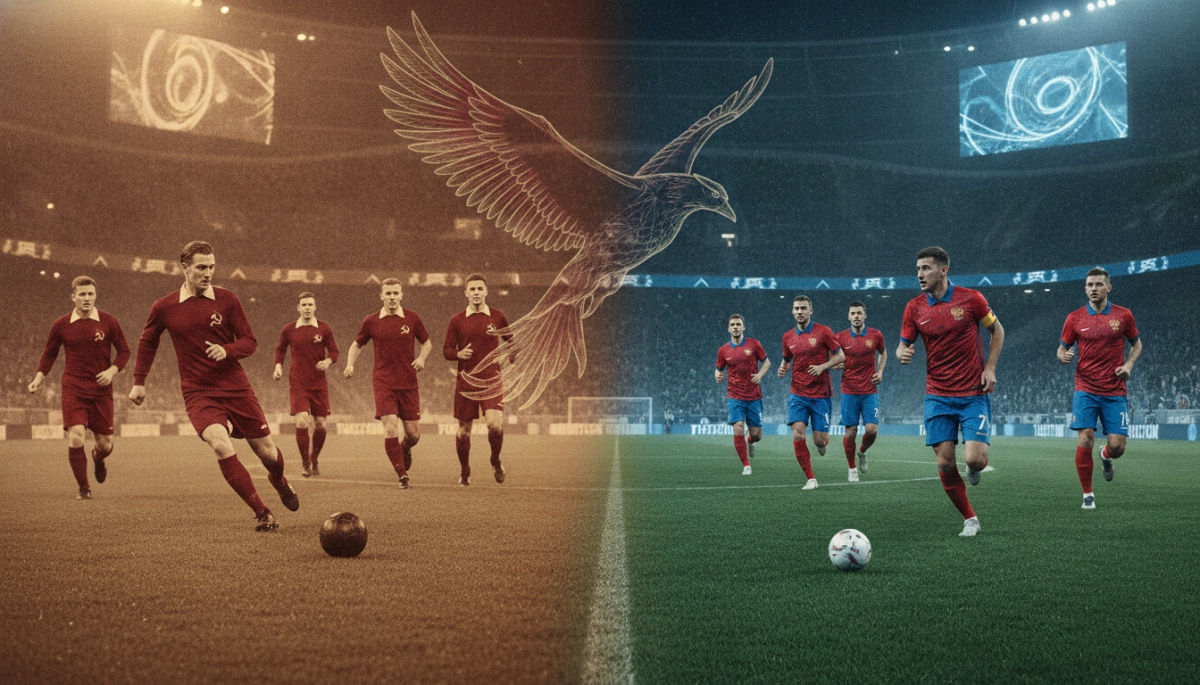
From the Soviet Football Machine to a Global Stage
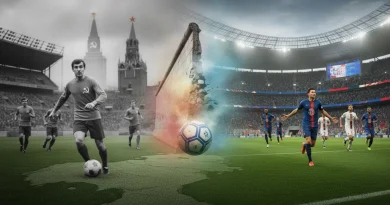
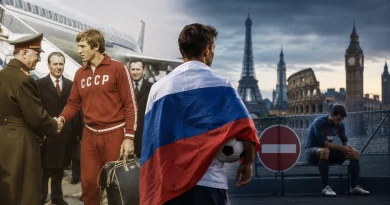
Long before Russian footballers became familiar names in European club football, their craft was being shaped inside one of the most disciplined sports systems the world has ever produced. The Soviet Union treated football as a state-backed enterprise, complete with specialized academies, tactical doctrine, and rigorous physical conditioning. Clubs like Spartak Moscow, CSKA Moscow, and Dynamo Kyiv produced technically refined players who competed at the highest levels of UEFA competition throughout the Cold War era.
The 1988 Soviet national team, which reached the European Championship final, stands as the clearest testament to how far that system had advanced. Players schooled in collective, disciplined football regularly outmatched Western European sides with far greater commercial resources. The Soviet model prioritized positional intelligence and stamina over individual flair — a philosophy that shaped an entire generation whose careers would soon be interrupted by history itself.
When the USSR dissolved in 1991, the football landscape fractured overnight. Fifteen separate footballing nations inherited pieces of the old infrastructure but none of the unified resources. For Russia, the transition was turbulent. Clubs struggled financially, league structures were rebuilt under chaotic market conditions, and talented players found themselves navigating a professional environment that simply did not yet exist in recognizable form.
The European Transfer Wave and the Players Who Defined Russian Football Abroad
The 2000s marked a turning point. As Russian oligarchs invested heavily in domestic clubs and the broader European transfer market looked eastward for undervalued talent, skilled Russian players began reaching top-tier leagues. Those who did left a lasting impression.
Andrei Arshavin’s time at Arsenal remains the most iconic chapter. His quadruplet against Liverpool at Anfield in 2009 announced, loudly and unmistakably, that Russian players belonged in elite Premier League conversations. Pavel Pogrebnyak made his mark in Germany and England, while Igor Akinfeev cemented himself as one of Europe’s most consistent goalkeepers despite rarely leaving CSKA Moscow. These players shaped how European football viewed the Russian game — not as a curiosity, but as a legitimate source of technical quality.
Their reputations were built on Soviet-trained discipline and genuine hunger. Their careers abroad were hard-earned, rarely cushioned by the agent networks and commercial infrastructure that South American or Western European players had long enjoyed.
The Structural Barriers That Preceded the Ban
It would be inaccurate to frame the decline of Russian footballers in European football as something that began only with the invasion of Ukraine in February 2022. The structural barriers had been accumulating quietly for years, shaped by domestic wealth, political climate, and a football culture that increasingly rewarded players for staying home.
The explosion of oil and gas money into the Russian Premier League from the mid-2000s created a paradox. It raised the quality of domestic football, but it also made the financial incentive to leave Russia considerably weaker. A technically gifted Russian midfielder in his mid-twenties could earn wages in Moscow rivaling mid-table Bundesliga contracts, without relocating, learning a new language, or adapting to a faster tactical environment. Comfort quietly dulled ambition.
European clubs also began perceiving Russian players as complicated signings. Work permit regulations, administrative complexity, and wariness around politically connected club ownership made recruitment a bureaucratic burden many sporting directors preferred to sidestep. By the early 2010s, the trickle of Russian talent moving into elite European leagues had slowed to barely a drip, even as individual quality within the domestic system remained genuinely high.
The Crimea Effect and Football’s Gradual Political Awakening
The annexation of Crimea in 2014 introduced a new dimension to Russian football’s international profile. While FIFA and UEFA stopped short of sweeping exclusions, the political atmosphere shifted perceptibly. Sponsorship decisions became more careful, broadcasting deals more cautious, and the background noise around Russian clubs with oligarch ownership grew steadily louder.
For emerging talents attempting to attract interest from abroad, the climate had changed in ways difficult to quantify but impossible to ignore. Russian players were no longer simply footballers from a competitive eastern European league — they were assets that arrived with geopolitical footnotes attached.
The 2018 World Cup, hosted on Russian soil, offered a brief counternarrative. Stanislav Cherchesov’s pragmatic side reached the quarterfinals, eliminating Spain in a penalty shootout that produced scenes of genuine national euphoria. Aleksandr Golovin caught the attention of European clubs — Monaco moved quickly to sign him — and there was a momentary sense that Russian football might re-engage with the international market on favorable terms. It was, in retrospect, the last significant window before everything changed.
2022 and the Sudden Erasure of a Career Path
The UEFA suspension of Russian clubs and the national team following the invasion of Ukraine did not simply remove Russia from competition. For footballers mid-career, it eliminated an entire professional pathway overnight. Players contracted to European clubs found themselves in legal grey zones, with some clubs terminating arrangements early and others negotiating mutual departures to avoid reputational complications. The message was clear, swift, and professionally devastating regardless of players’ personal political positions.
Golovin, who had built a solid career at Monaco, found himself in one of the more visible dilemmas: a Russian passport had become a tangible liability in a sport that had previously treated nationality as largely irrelevant to marketability. Others faced starker choices:
- Players on loan at European clubs were recalled or released without normal market negotiation.
- Young Russian talents at European academies faced uncertainty about their long-term futures in those systems.
- National team football was suspended indefinitely, removing a key platform for individual exposure.
- Some players began exploring naturalization in other countries — a process that is legally complex and emotionally fraught.
What made the situation particularly acute was its lack of clear precedent. The suspension of Yugoslav clubs during the 1990s conflicts offered a partial comparison, but the global interconnectedness of contemporary football meant Russian football’s exclusion was total rather than partial. The door had not merely closed; it had been publicly locked from the outside, with no announced timeline for reconsideration.
A Legacy Suspended, Not Erased
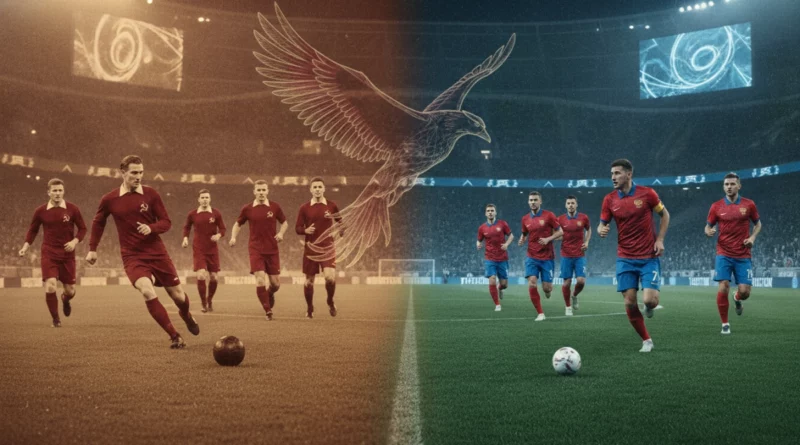
What the arc of Russian football ultimately reveals is a story shaped as much by history as by talent. The players who emerged from Soviet academies carried a technical education that was, in many respects, ahead of its time. Those who followed had to construct careers in a landscape simultaneously opening and closing. Those playing today carry the weight of circumstances no amount of skill could have prepared them for.
The cruelty of the current moment is generational. A Russian footballer born in 2001 has spent his most formative professional years inside a system cut off from the competitive infrastructure that defines European football’s evolution. There are no Bundesliga loan spells sharpening tactical awareness, no Champions League nights building a global résumé — only a domestic league playing in effective isolation, talented but sealed from the pressures and opportunities that historically produce the best players.
The handful of Russian footballers remaining at European clubs — Golovin most prominent among them — now represent something beyond their individual careers. They are, perhaps unwillingly, the final visible link between a tradition of Russian footballing excellence stretching back to the Spartak sides of the 1980s and a present with very few pathways forward.
Whether Russian football eventually re-enters the international stage — through a resolution of the conflict, a change in political circumstance, or a gradual softening of governing body positions — remains genuinely uncertain. UEFA’s official position on the suspension of Russian football offers little indication of when or under what conditions that door might reopen. What is certain is that when it does, the gap will be measurable — in missed development years, in absent European experience, in a generation of players whose potential was real but whose opportunities were not.
The Soviet football machine produced players who competed at the highest levels despite a curtain that limited their exposure to the outside world. Russian football survived the chaotic dissolution of an empire and rebuilt, imperfectly but genuinely, into something capable of producing players admired across Europe. Those facts belong to a record that no suspension can retrospectively erase. What remains to be written is whether the next chapter will be authored from the outside looking in, or once again from within the rooms where the game’s real conversations take place.