Russian Footballers in Europe: How Soviet Training Built the Foundation for a Generation Abroad
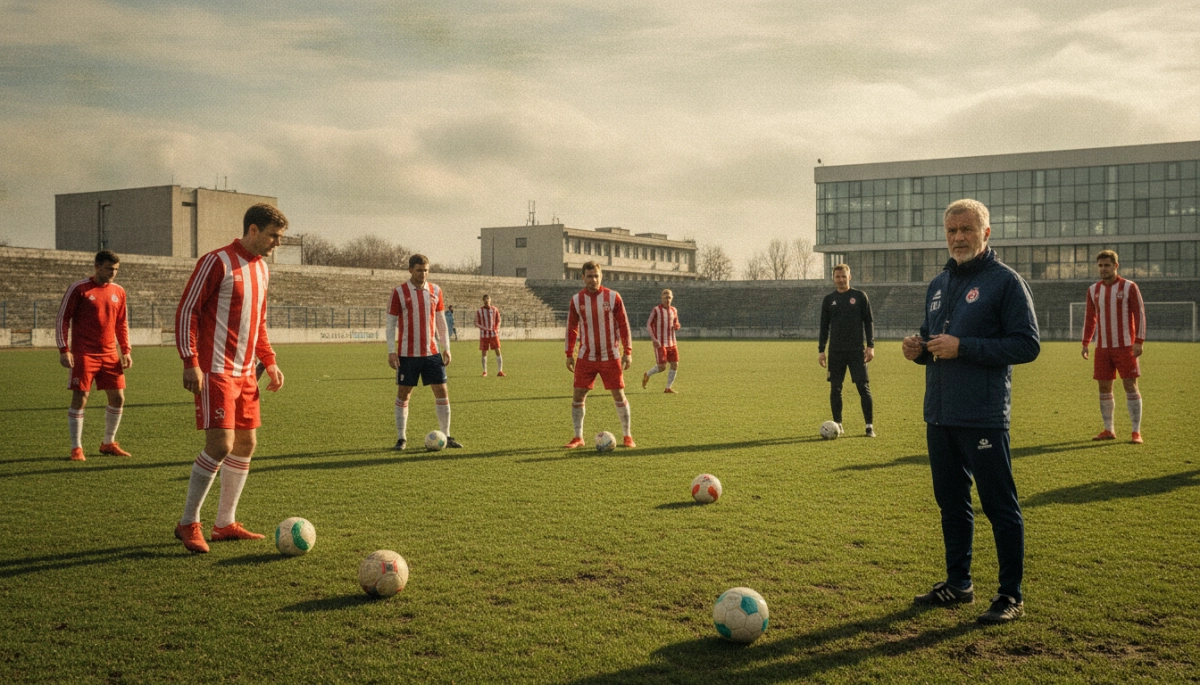
When the Iron Curtain Lifted, Soviet Football Followed
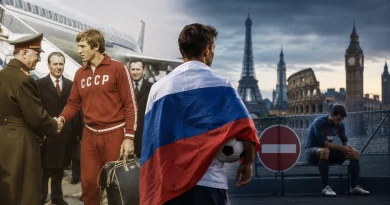
The collapse of the Soviet Union in 1991 did not simply redraw political borders — it unlocked the movement of an entire generation of footballers trained under one of the most systematic athletic programmes the world had ever seen. For decades, the Soviet sports machine had produced players of remarkable technical quality and physical conditioning, yet few outside the Eastern Bloc could watch them compete regularly. When that barrier fell, European clubs moved quickly, and Russian and post-Soviet talent began flowing westward in ways that would reshape several top-flight leagues.
What made this migration significant was not merely the quantity of players crossing borders, but the distinctive identity they carried. These were not raw recruits discovering professional football for the first time. They were products of centralised academies, rigorous tactical schooling, and a culture that placed collective discipline above individual flair — an asset in some contexts, a quiet complication in others.
The Soviet Athletic System and Its Lasting Imprint
The USSR operated a state-funded network of sports schools that identified talent early, sometimes as young as six or seven, and placed children into structured long-term development programmes. Football academies emphasised positional awareness, stamina, and technical repetition over creativity. The results were players who understood space exceptionally well and could sustain high physical output consistently across ninety minutes.
Tactically, Soviet football was shaped by structured pressing, disciplined defensive lines, and purposeful transitions. Coaches treated football as a science of movement and geometry rather than a canvas for improvisation. That outlook produced players who were reliable rather than spectacular — until, in the right environment, greater freedom unlocked something more.
The careers of Andrei Kanchelskis, Andrei Arshavin, and Roman Pavlyuchenko illustrate different facets of that Soviet inheritance. Each arrived in European football with attributes forged by the same foundational system, yet each found relevance in leagues that demanded different things.
Kanchelskis and the Winger Reimagined for the Premier League
When Kanchelskis arrived at Manchester United from Shakhtar Donetsk in 1991, English football was still in transition — physically brutal, suspicious of foreign players, and largely unfamiliar with what the Soviet game had produced. Into that environment stepped a wide midfielder whose most obvious attribute was blistering acceleration, but whose deeper value was less immediately visible.
Soviet football had taught Kanchelskis to think collectively. Wingers were not given licence to roam; they pressed from defined angles and contributed to defensive recovery with the same seriousness they brought to attacking play. That dual obligation was not a constraint he had to consciously adopt at Old Trafford — it was simply how he understood the role. Ferguson recognised it immediately. In a squad built on hard work as much as talent, a winger who could be trusted defensively without sacrificing his offensive threat was genuinely rare.
What the Premier League gave Kanchelskis that Soviet football could not was space. Wider pitches and slightly stretched defensive lines created corridors that suited his direct running. His Soviet conditioning, which emphasised sustained intensity over ninety minutes rather than isolated bursts, meant he rarely faded when English wingers around him were visibly tiring. The system had built him for endurance as much as speed, and in the English game of that era, that combination proved close to ideal.
Arshavin’s Intelligence and the Question of Creative Freedom
Where Kanchelskis represented the physical dividend of Soviet training, Arshavin offered different evidence — that the same system could also nurture genuine creative sophistication. He arrived at Arsenal in January 2009 after a career at Zenit Saint Petersburg that had already established him as one of Russia’s most technically gifted players. European observers were essentially catching the tail end of a quietly magnificent prime.
Arshavin’s style drew on Soviet positional theory in ways not always obvious from the outside. He was compact rather than explosive, preferring tight spaces, receiving under pressure and releasing with precision that spoke to thousands of hours of technical drilling. Soviet academies used small-sided drills to develop decision-making speed under spatial constraint. The unintended consequence, in a player of Arshavin’s intelligence, was a footballer capable of reading situations several beats ahead of opponents.
At Arsenal, Wenger gave him something the Soviet system had been structurally reluctant to provide: permission to trust his instincts. The four-goal performance against Liverpool at Anfield in April 2009 was not a sudden revelation — it was the expression of a technical foundation laid over decades, given room to breathe within a system that rewarded imagination. That he never sustained that level reflects a broader tension many post-Soviet players experienced: a formation designed for collective reliability does not automatically produce the individual durability required to carry a club career in isolation.
Pavlyuchenko and the Striker’s Burden of Expectation
Roman Pavlyuchenko’s time at Tottenham Hotspur between 2008 and 2012 illuminates another dimension of the Soviet inheritance — how a striker shaped by that tradition could thrive in flashes while struggling to meet the consistent output demands of a top-half Premier League club. His arrival followed a strong record at Spartak Moscow, where his movement off the ball and penalty-area finishing had made him one of Russia’s most dangerous forwards.
Soviet striker training emphasised positional intelligence above athleticism. Rather than building forwards who pressed relentlessly across defensive lines, the tradition favoured strikers who conserved energy, chose their moments, and arrived with precision where the ball was likely to fall. Pavlyuchenko was a product of that philosophy — capable of genuine quality from minimal involvement, but not naturally suited to the high-volume participation that Redknapp increasingly required.
The tension this created was not simply about work rate, as English commentary often lazily framed it. It was a philosophical mismatch between a striker whose effectiveness was rooted in economy of movement and a league culture that equated visibility with contribution. When Pavlyuchenko was involved, his touch and finishing instinct were unmistakably those of a well-coached professional. That the spaces between those moments felt long to English observers said as much about differing expectations as any deficiency in the player himself.
What the Migration Left Behind — and What It Still Explains
The stories of Kanchelskis, Arshavin, and Pavlyuchenko are not simply individual biographies of Russian footballers. They are case studies in what happens when one sporting culture is transplanted into another. That three players sharing the same foundational formation produced such different outcomes is itself instructive. The Soviet system did not manufacture identical products — it established a common framework within which genuinely different temperaments were shaped, and Europe revealed what that framework contained.
What European clubs discovered was that the Soviet athletic tradition had solved certain problems with considerable sophistication — conditioning, positional discipline, technical repetition, tactical structure — while leaving others largely unaddressed. The psychological dimension of performing as an individual within a commercially pressurised, media-saturated football culture was something no Soviet academy had prepared players for, because that culture had not existed behind the Iron Curtain. The adjustment required was temperamental as much as tactical, and it proved harder for some than others.
Arshavin captured this tension most vividly. At his best, he demonstrated that the Soviet emphasis on intelligence and technical precision could produce a player capable of competing at the very highest level. At his most frustrating, he was a reminder that individual brilliance requires individual resilience to sustain itself — cultivated less by collective training programmes than by the particular psychological architecture of the player himself. The system gave him his tools. What he built with them, and how long it held, was ultimately his own.
The broader migration also reshaped how European clubs thought about talent identification in Eastern Europe. Scouts who had ignored the Soviet leagues began to understand that technical quality existed there in abundance, if in unfamiliar forms. The challenge was always contextualisation — recognising that a player who looked modest within a restrained tactical system might flourish with greater freedom, or conversely, that dominance in Russia’s structured environment might not survive the demands of top-level European football. That interpretive challenge, in modified form, persists even now.
What the first generation of Russian footballers in European leagues ultimately demonstrated is that sporting cultures are not interchangeable, but they are translatable. The Soviet system produced footballers who were, in certain respects, ahead of tactical thinking that English and continental football would take another decade to fully embrace — pressing organisation, positional compactness, physical periodisation designed for longevity. That those ideas arrived embedded in individual players rather than coaching methodologies meant their influence was felt more quietly than it might have been. But it was felt nonetheless, and the careers of Kanchelskis, Arshavin, and Pavlyuchenko remain its most human and enduring record.