Russian Tennis: How Soviet Roots Built a Generation of Grand Slam Champions
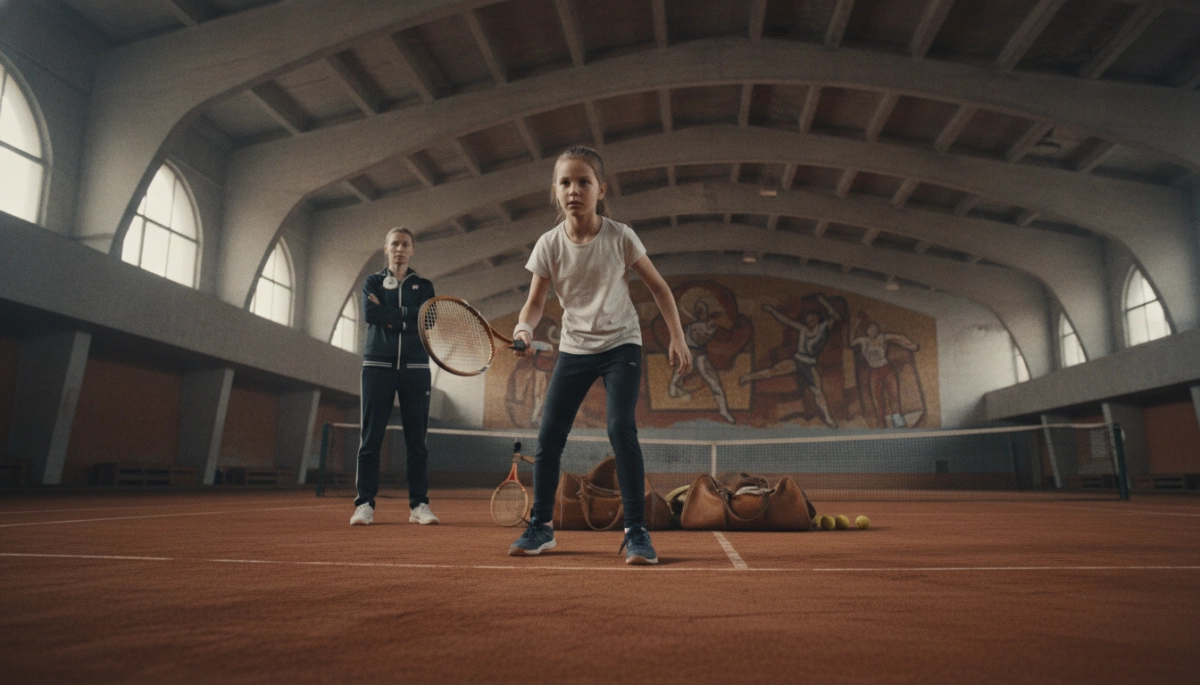
From Soviet Courts to Global Stages: The Foundations of Russian Tennis
Long before Marat Safin was demolishing Pete Sampras at the US Open or Maria Sharapova was commanding Centre Court at Wimbledon, the infrastructure that made those moments possible was already decades in the making. The Soviet Union did not produce world-class athletes by accident. It built them — methodically, systematically, and with a level of state investment most Western nations could scarcely imagine. Sport was inseparable from ideology, and the machinery constructed to serve that ideology left behind something lasting: a blueprint for athletic excellence that the post-Soviet generation would inherit and transform.
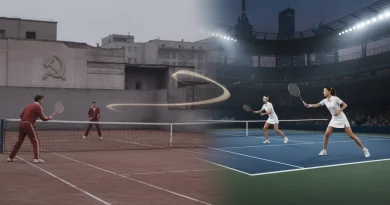
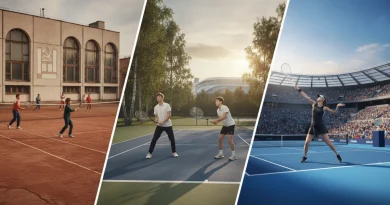
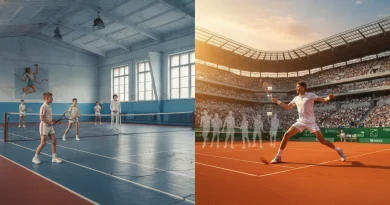
Tennis occupied a peculiar position in the Soviet sporting hierarchy. For much of the Cold War era, it was viewed with suspicion — an individualistic, bourgeois pastime ill-suited to the collective spirit of socialist competition. Yet coaching expertise accumulated quietly, facilities remained functional, and a culture of disciplined physical training permeated every corner of the system. When the Soviet Union collapsed in 1991, that infrastructure did not simply vanish. It fractured and fragmented, but the knowledge remained — in the heads of coaches, in the muscle memory of young players, in the habits of a sporting culture that had spent seventy years perfecting elite athlete development.
The Post-Soviet Transition: Chaos, Opportunity, and a New Generation
The 1990s were a decade of turbulent reinvention for Russian sport. State funding evaporated almost overnight, yet this disruption created an unexpected opening. As rigid Soviet structures loosened, Russian players gained something entirely new: the freedom to compete internationally, train abroad, and engage with the global professional circuit on their own terms.
Young Russian players who had received foundational training within the remnants of the Soviet system began supplementing that education with international coaching methods and competition exposure. The combination proved potent. By the late 1990s and into the early 2000s, a wave of exceptionally talented Russian players broke into the upper echelons of the world rankings — not as isolated anomalies, but as a recognizable cohort arriving in succession with a consistency that announced something structural rather than coincidental.
Safin’s explosive ascent, Sharapova’s extraordinary mental fortitude, and the later emergence of Anastasia Myskina and Svetlana Kuznetsova all pointed to the same source: a pipeline constructed under one political system and adapted, imperfectly but effectively, to serve another.
Marat Safin and the Arrival of a New Archetype
Marat Safin did not ease himself into the world’s consciousness. He arrived at full velocity, with a racket swing that looked borrowed from a heavier sport and a temperament that made watching him feel like standing close to something combustible. When he demolished Pete Sampras in straight sets at the 2000 US Open to claim his first Grand Slam title, he was twenty years old and already playing tennis that seemed to belong to a future the sport hadn’t quite reached yet.
Safin had trained partly in Moscow and partly in Valencia, Spain, where coaches blended the Soviet emphasis on physical conditioning and stroke mechanics with a more tactically fluid approach to match play. That hybrid education defined the best Russian players of his generation. The foundation was Soviet. The finishing was international. The result was something neither system could have produced alone.
What often gets underemphasized is what Safin represented symbolically at that precise moment. He proved, in the most emphatic terms possible, that a Russian man could not merely compete at the highest level but dominate it. His second Grand Slam title — a five-set victory over Lleyton Hewitt at the 2005 Australian Open — delivered that message a second time for those who had treated the first as an outlier.
Maria Sharapova: Discipline as a Competitive Weapon
Where Safin embodied volatility, Maria Sharapova embodied something closer to its opposite. Her rise from a young girl who left Russia for Florida at age seven — sent abroad by a father carrying little money and enormous ambition — to a five-time Grand Slam champion is a story about will as much as talent. Sharapova’s game was never built on effortless genius. What she possessed instead was a capacity for sustained, ruthless self-improvement that the Soviet coaching tradition had always valued above raw ability.
Her training under Nick Bollettieri blended American intensity with the technical rigor absorbed in her early years. The groundstrokes were heavy and precise. The mental resilience was extraordinary. And the serve — that towering, thunderous delivery that became her signature — was the product of thousands of repetitive hours rather than innate physical gift. Sharapova was almost clinically clear-eyed about this, speaking often of preparation, marginal improvements, and approaching each match as a problem to be solved.
Her 2004 Wimbledon title, won at seventeen against Serena Williams, announced her to the world. But it was the consistency she maintained over the following decade — returning from serious shoulder surgery, winning Roland Garros in 2012 and again in 2014 — that cemented her place in the sport’s history. She represented something specific about the Russian tennis tradition: the idea that physical gifts are merely raw material, and that the real work happens in the daily grind of refinement no television camera ever captures.
The Structural Conditions Behind the Champions
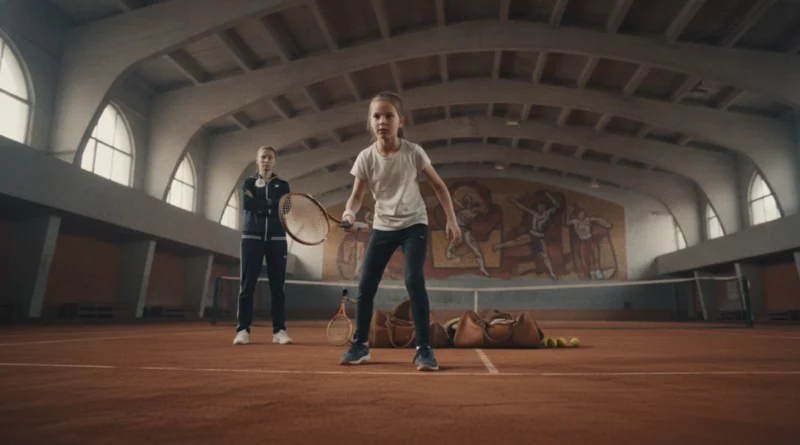
To understand why Safin and Sharapova were not isolated phenomena but early markers of something systemic, it helps to examine what was happening simultaneously at the level of Russian tennis administration. Through the late 1990s and into the 2000s, the Russian Tennis Federation worked to rebuild domestic infrastructure. Academies were reopened, regional programs revived, and a philosophy emphasizing early specialization and high-volume technical training took hold — directly inherited from the Soviet model, now better resourced.
Several conditions converged to accelerate this development:
- The emergence of private investment in Russian sport, as newly wealthy business figures began sponsoring academies and individual players previously reliant on state support.
- An expanding network of coaches trained under the Soviet system but now with access to international methodologies and competition data.
- Russia’s integration into the global professional circuit, giving promising juniors far more competitive match play at younger ages than their Soviet-era predecessors had experienced.
- A cultural expectation, embedded within the training environment, that hardship and discomfort were not obstacles to development but essential instruments of it.
Together, these factors created conditions in which talent could be identified early, developed intensively, and tested internationally — a cycle that repeated often enough to produce not one or two exceptional players, but an entire generation of them.
Daniil Medvedev and the Continuity of a Tradition
If any doubt remained that Russian tennis had built something durable rather than merely fortunate, Daniil Medvedev resolved it. Born in Moscow in 1996, he belongs to a generation that never experienced the Soviet system firsthand yet was shaped entirely by the culture it left behind. His tennis is a distillation of everything that tradition valued: ferocious physical conditioning, an almost algorithmic approach to tactics, and psychological composure under pressure that looks unnatural until you understand where it comes from.
Medvedev lost three major finals before winning the 2021 US Open, each defeat absorbed and converted into information rather than scar tissue. The way he processed setbacks — analytically, without visible devastation — recalled the Soviet coaching philosophy’s insistence that failure is data, not disaster. When he finally claimed that title, defeating Novak Djokovic in three commanding sets to deny him a calendar Grand Slam, he did so with the methodical certainty of someone who had rehearsed the moment long before it arrived.
His rise signaled something broader: that Russian tennis was not experiencing a golden era so much as a sustained standard. From Safin to Sharapova to Kuznetsova to Medvedev and Andrey Rublev, the pipeline kept delivering. That consistency is the real achievement — not any single title, however spectacular, but the unbroken chain of excellence connecting one generation to the next.
The Legacy That Courts Built
What Soviet sports planners set in motion — even without tennis as a priority, even under an ideology that distrusted the sport’s individualist spirit — ultimately produced one of the most remarkable national contributions to the game’s modern history. The mechanism was never magic. It was repetition, rigor, and a belief that developing athletic excellence was a serious undertaking worthy of serious investment. Post-Soviet Russia inherited that belief, adapted it to a new economic and competitive reality, and let it compound across decades.
Safin’s ferocity, Sharapova’s relentlessness, Medvedev’s precision — these are not variations on the same personality so much as different expressions of the same underlying formation. What they shared was a preparation culture that refused to treat talent as sufficient on its own. In a sport that rewards those who endure, Russian tennis built endurance into the system itself.
That, more than any single trophy or ranking milestone, is the true measure of what Russia has contributed to global tennis. Not a moment, but a method. Not a champion, but a tradition — still producing, still competing, and still making itself impossible to ignore.