Russian Footballers in European Club Football: From Soviet Roots to the Modern Era
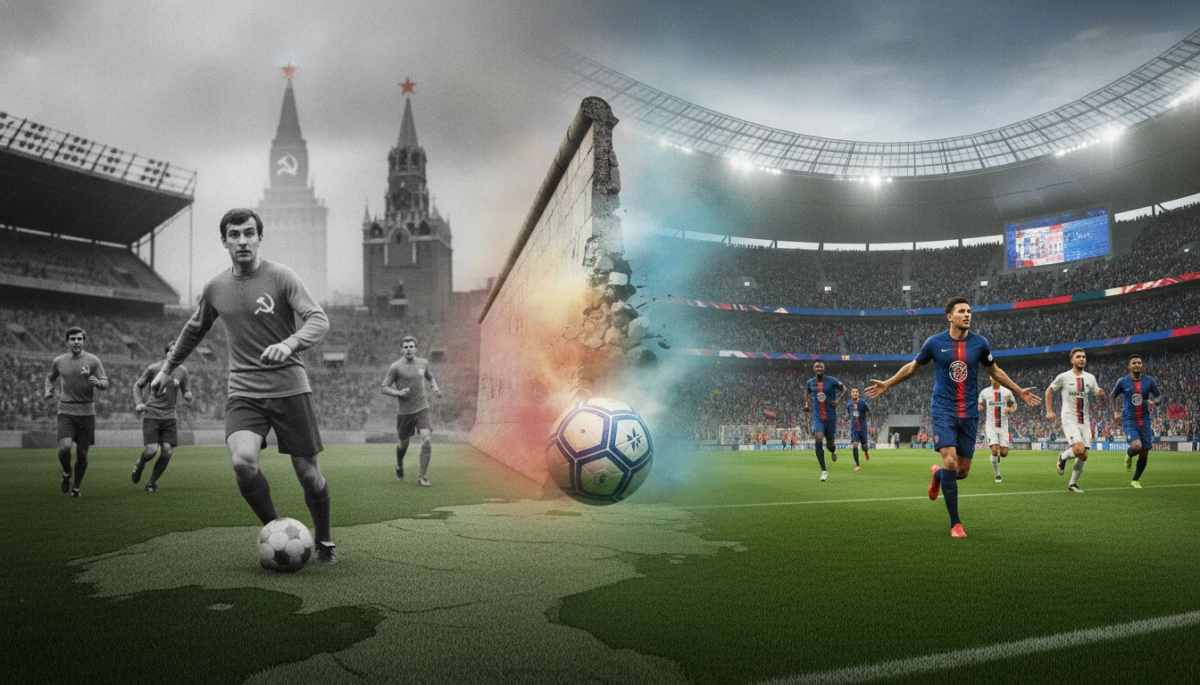
The Soviet Foundation That Shaped a Football Identity
Long before the phrase “Russian footballer” carried its current geopolitical weight, the Soviet Union had already carved a distinctive identity into world football. The USSR won the inaugural European Championship in 1960, and Lev Yashin became a symbol not just of Soviet sporting ambition but of a philosophical approach to the game: disciplined, collective, and deeply technical. These qualities were engineered through a state-sponsored system that treated elite athletes as national assets and invested accordingly.
Soviet club football, while largely sealed off from Western Europe’s commercial circuits, produced genuinely world-class players. Clubs like CSKA Moscow, Spartak Moscow, and Dynamo Kyiv became development engines for generations of talent who, had history unfolded differently, might have filled European rosters decades earlier. The talent was never the question. The political architecture surrounding it was.
That architecture collapsed in 1991, triggering one of the most turbulent transitions in football history — a scramble for opportunity that would define how the world came to see the post-Soviet footballer.
From Iron Curtain to Transfer Market: The Post-USSR Exodus
The dissolution of the Soviet Union triggered an almost immediate dispersal of talent across Europe. For the first time, players tied to club systems with no meaningful freedom of movement could negotiate their own futures. The results were messy, often exploitative, and yet historically significant.
Russian players faced a complex transition. Unlike their Ukrainian or Georgian counterparts, they arrived in European leagues with a mixture of curiosity and caution attached to them. Early movers faced language barriers, cultural adjustment, and clubs uncertain how to integrate players trained under a fundamentally different footballing philosophy.
- Early post-Soviet transfers often involved opaque intermediaries and poorly structured contracts
- Scandinavian and German leagues served as frequent stepping stones before moves to England, Spain, or Italy
- Russian players had to relearn football not just technically but commercially — adapting to a sport now governed by market logic rather than state mandate
This transitional generation rarely received the recognition it deserved. But its struggles and occasional breakthroughs created the pathway that players like Andrei Arshavin would later walk with far greater visibility — and into far brighter spotlights.
The Arshavin Generation: Russia’s European Moment
If any single player captures what Russian football achieved at its international apex, it is Andrei Arshavin. Small, technically precise, and possessed of an instinctive creativity that confounded defenders, Arshavin arrived at Arsenal in January 2009 as something more than a transfer — he arrived as a statement. Russia had just produced a genuine European Championship performance the previous summer, finishing third, and Arshavin had been its heartbeat. His four goals against Liverpool at Anfield in April 2009 became one of the Premier League era’s most celebrated individual displays, and for a brief, luminous period he was among the most compelling attacking players in England.
His success shifted the perception of Russian players in European football from curiosity to credible commodity. Scouts who had been hesitant reconsidered. Clubs that had viewed the Russian league as an impenetrable source of talent began to recalibrate. Arshavin was not alone: Roman Pavlyuchenko brought physical directness to Tottenham Hotspur, while Diniyar Bilyaletdinov made his own impression at Everton. None quite matched Arshavin’s ceiling, but their collective presence gave Russian football a genuine multi-club footprint in England for the first time. The national team’s 2008 success under Guus Hiddink served as the commercial backdrop — a reminder that international performance and club migration have always been intertwined.
Structural Barriers and the Limits of Individual Brilliance
Despite these moments of genuine integration, Russian football never built the sustained pipeline the early 2000s seemed to promise. The Russian Premier League, increasingly flush with post-oil-boom investment, became financially competitive in its own right. Clubs like Zenit St. Petersburg and CSKA Moscow could offer wages rivalling mid-table European outfits, making the calculation of leaving look less compelling over time.
This dynamic had a complicated effect on player development. It demonstrated the growing commercial weight of Russian club football, but it also insulated players from the competitive pressures that tend to accelerate development at elite European clubs. Playing well in a financially comfortable domestic environment is a very different proposition from competing week-to-week in the Premier League or La Liga, where marginal quality differences are immediately and publicly exposed.
The Role of Foreign Managers and Tactical Influence
One underappreciated thread is the role of foreign managers within the Russian system. Figures like Hiddink brought genuine tactical modernisation and temporarily elevated Russia’s international performance. But the reliance on imported expertise masked a deeper weakness in homegrown coaching infrastructure — one that became more apparent as results plateaued following the 2018 World Cup. Russian players, shaped by Soviet-era technical foundations overlaid inconsistently with foreign tactical ideas, often arrived at European clubs slightly out of phase with prevailing orthodoxies. The players themselves were rarely the limiting factor. The system producing them was.
Geopolitical Fault Lines and Their Football Consequences
The sanctions imposed on Russia following its invasion of Ukraine in 2022 introduced a rupture without modern precedent in European football administration. UEFA’s decision to suspend Russian clubs and the national team from all competitions was swift and sweeping. For Russian players already established at European clubs, the situation became immediately complicated in ways extending well beyond sporting concerns.
- Russian players faced scrutiny over their public statements — or conspicuous silence — regarding the war in Ukraine
- Young players on development pathways through European academies faced uncertainty about long-term eligibility
- The suspension of the national team effectively paused an entire generation’s international development at a critical stage
- Some players explored eligibility switches or moves to leagues outside UEFA jurisdiction, reflecting how thoroughly the sporting and political had become entangled
What makes this moment historically distinctive is how thoroughly it reversed a decades-long trajectory. Russian football had spent thirty years building cautious, incremental integration into European football’s structures — commercially, competitively, and culturally. The events of 2022 compressed that progress into a question mark. The players who remain active abroad do so in a climate where national identity carries costs that Arshavin’s generation never had to calculate.
What Remains When the Politics Recede
Football has always absorbed the turbulence of history — sometimes as a mirror, sometimes as an escape, and occasionally as a casualty of forces its participants neither created nor control. The longer arc of Russian football’s story, however, resists reduction to its most recent and most painful chapter.
The lineage is real and earned. From Yashin’s improbable brilliance in goal, through the hard-won European foothold of the transitional 1990s generation, to Arshavin’s luminous peak at Arsenal — Russian football built something substantial across six decades of international engagement. That it was built unevenly, under strange pressures, and with the constant interference of political circumstance does not diminish what was achieved. It contextualises it.
The generation now coming of age inside Russia faces a genuinely different set of calculations from any that preceded it. International football is not a horizon gradually coming into focus — it is, for the moment, a horizon that has been administratively closed. Whether that closure proves temporary or structural will depend on geopolitical developments no footballer can influence. For analysts and historians of the game, the relevant question is not whether Russian football will re-engage with European structures — it almost certainly will, eventually — but what form that re-engagement takes, and whether the institutional lessons of the past thirty years have been genuinely absorbed or merely deferred. UEFA’s national association rankings offer a useful window into how comprehensively a nation’s footballing ecosystem is measured beyond its most famous individuals — and how quickly decades of progress can stall when the conditions sustaining it fracture.
The history of Russian footballers in European and international competition is not a closed book. It is a book with a chapter that ends mid-sentence, written in a hand that once showed genuine promise, waiting — as football so often has to wait — for the world around it to settle enough to allow the next line to be written.