Russia’s Olympic Championship Legacy: From Soviet Dominance to the Modern Era
The Foundation of a Sporting Empire: How the Soviet Union Rewrote Olympic History
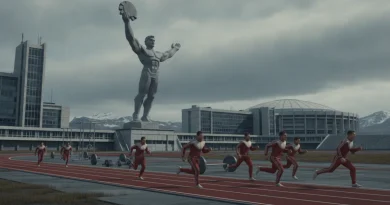
When the Soviet Union made its Olympic debut at the 1952 Helsinki Games, the global sporting order shifted almost overnight. A nation that had spent decades constructing a state-sponsored athletic infrastructure suddenly revealed what centralized training, ideological motivation, and systematic talent development could produce at the highest level. Over the following four decades, Soviet athletes accumulated an extraordinary haul of Olympic gold medals, transforming what had been a largely Western-dominated competition into a genuine Cold War battlefield fought on tracks, gymnastics floors, wrestling mats, and ice rinks.
The Soviet model was unlike anything the world had seen before. Sports schools identified gifted children early, funneling them into specialized programs where coaches, nutritionists, and sports scientists worked in coordinated teams. Disciplines like gymnastics, athletics, weightlifting, and wrestling became Soviet specialties — areas where the medal count was not just competitive but overwhelming. Figure skating offers one of the clearest illustrations of this dominance. The lineage of champions produced through clubs like CSKA Moscow, coached by legendary figures such as Stanislav Zhuk and Tamara Moskvina, created a tradition so deep-rooted that it would survive the political collapse of the USSR itself. The olimpijski šampioni rusija of the post-Soviet era inherited this tradition even as they competed under entirely different flags and within a dramatically changed geopolitical landscape.
1992 and the Unified Team: Continuity Beneath a Different Banner
The dissolution of the Soviet Union at the end of 1991 presented the IOC with an unprecedented challenge. Twelve former Soviet republics competed at the 1992 Albertville and Barcelona Games under the Unified Team banner — designated EUN. When athletes stood on the podium, no national anthem played. Instead, the Olympic hymn rang out, a quiet acknowledgment that an era had ended before a new one could be defined.
Yet the performances told a story of unbroken excellence. The Unified Team finished atop the Barcelona medal table, its athletes carrying decades of Soviet coaching methodology into a competition that felt like both a farewell and a beginning. Wrestlers, gymnasts, and track and field athletes who had trained entirely within the Soviet system stepped onto the Olympic stage representing something that no longer formally existed — and still dominated. That moment demonstrated that athletic infrastructure, coaching lineages, and competitive culture built over forty years could not simply be dissolved along with a political entity.
Russia Finds Its Footing: Building an Independent Olympic Identity Through the 1990s
The years following Barcelona were difficult. Funding dried up almost overnight. Sports schools that had operated with guaranteed state budgets suddenly competed for resources in a chaotic post-Soviet economy. Coaches watched their most talented athletes contemplate emigration — to train abroad, compete for other nations, or simply find economic stability that Russian sport could no longer guarantee.
And yet the 1996 Atlanta Games revealed something important: the foundations held. Russia’s independent Olympic debut was far from the collapse some had predicted. Athletes across wrestling, athletics, and gymnastics continued to perform at the highest level, even as the administrative apparatus around them remained unstable. The competitive instincts and technical preparation absorbed over decades could not be undone by political reorganization.
Gymnastics provided some of the most vivid evidence of this continuity. The women’s artistic program, which had produced a virtually unbroken line of Soviet champions dating back to the late 1950s, maintained its identity through coaches who had trained multiple generations of champions. By the late 1990s, Russian gymnastics was establishing itself as the natural heir to Soviet dominance — even as the sport grew more competitive and technically complex than ever before.
Landmark Champions and the Sports That Defined Russian Olympic Prestige
Across decades of Russian Olympic participation, certain disciplines became so consistently associated with excellence that they came to define the country’s international sporting identity. Wrestling — both freestyle and Greco-Roman — represented perhaps the most sustained example. Multiple Olympic cycles produced champions whose dominance was not the product of single exceptional performances but of systematic superiority, year after year and weight class after weight class.
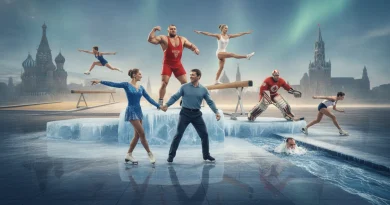
Figure skating, however, became the discipline most immediately recognizable to international audiences as the face of Russian Olympic achievement. Successive Russian pairs won Olympic gold medals across several decades. But it was ice dance and individual skating where Russia’s emotional connection to the sport was most visible — programs designed not merely to score technical points but to tell stories, demonstrating that athletic excellence and artistic expression could coexist within a competition framework.
Athletics and the Weight of Expectation
Track and field presented a more complicated picture. Russian athletics inherited the Soviet tradition but also the scrutiny that came with increasingly sophisticated international anti-doping frameworks through the 2000s and beyond. Within that contested landscape, genuine excellence still surfaced. Jumpers, pole vaulters, and multi-event athletes produced performances that were measurably world-class. The complexity of Russian athletics during this era is that it contains both authentic greatness and systemic failure — often within the same competitive period — making straightforward assessment genuinely difficult and historical judgment an ongoing rather than settled matter.
The Cultural Weight of Olympic Gold in the Russian Sporting Imagination
To understand why Olympic success carries such particular resonance in Russia, it helps to appreciate how deeply the Games became embedded in Soviet and then Russian cultural life. Victory at the Olympics was never simply a sporting achievement. It functioned as national validation — evidence that the system worked, that sacrifices demanded of young athletes and their families produced something genuinely worthwhile.
This cultural weight intensified during the uncertain 1990s, when Olympic medals represented one of the few arenas where Russia could still claim unambiguous international prestige. The figure skater arriving home with gold, the wrestler who had defended a title under difficult conditions, the gymnast who had delivered a near-perfect routine — these individuals carried a symbolic burden extending far beyond sport. They were evidence of survival and continuity, of a sporting culture that had outlasted the political circumstances that created it.
From Soviet Legacy to ROC: A Tradition That Outlasts Every Disruption
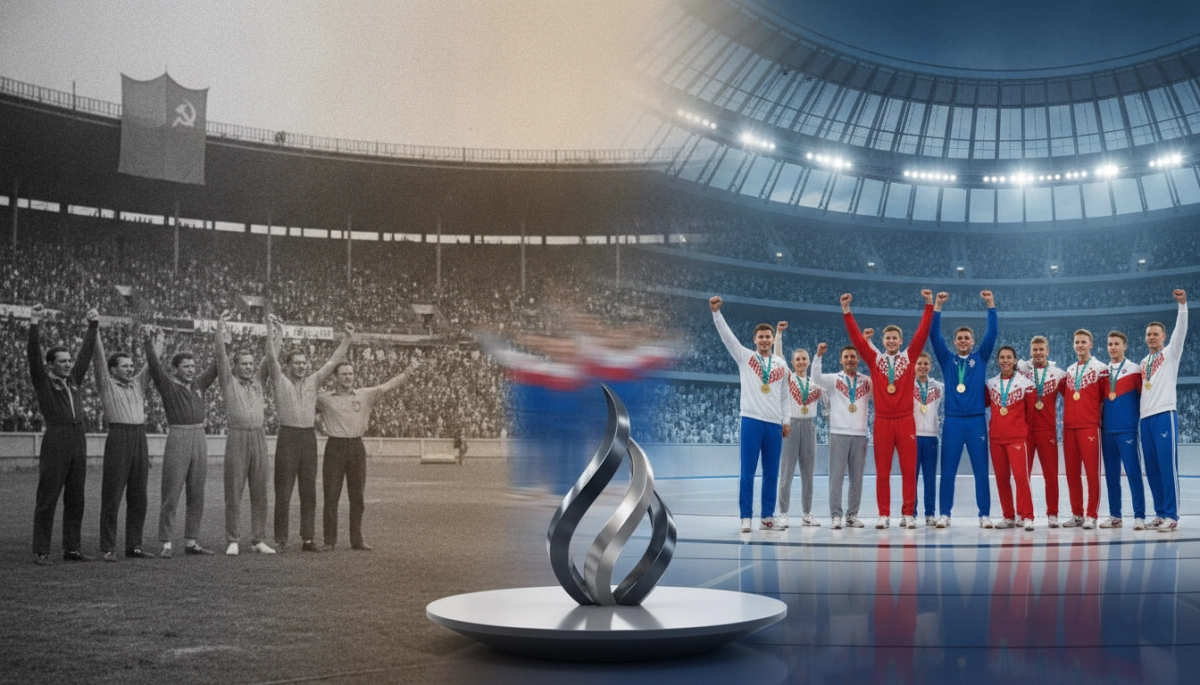
The formation of the Russian Olympic Committee as the competitive entity through which Russian athletes navigated the governance landscape of the 2020s represented, in historical terms, another transition rather than a rupture. The athletes who competed under the ROC designation at the Tokyo Games in 2021 did so within a lineage stretching back to Helsinki 1952 — defined not by flags or acronyms but by the transmission of knowledge, method, and competitive character from one generation to the next.
Figure skating continued to produce performers of exceptional technical ambition. Gymnastics remained a discipline where intensity produced both remarkable results and persistent ethical debate. Wrestling maintained its status as the quiet engine of Russia’s overall medal count — less glamorous than the rink or the gymnastics floor, but relentlessly productive. Across each discipline, what was visible was not merely talent but a particular relationship to preparation, difficulty, and the expectation of excellence built into the sporting culture over decades.
The turbulence of recent years — doping sanctions, neutral status provisions, and evolving IOC regulations — has inevitably complicated the story. Russian sport has been forced to reckon with institutional failures that cannot be minimized or argued away. And yet within that reckoning, individual athletes have continued to compete, to win, and to represent a tradition of craft and commitment that exists separately from the administrative failures surrounding it. Holding both truths simultaneously is necessary for any honest reading of this history.
What the full arc of Russia’s Olympic story demonstrates — from the first Soviet medals at Helsinki through the Unified Team’s dignified farewell, through the difficult 1990s reconstruction and into the championship performances of the modern era — is that sporting excellence of this depth is never the product of a single political moment. It is the product of accumulated human knowledge: coaches who learned from coaches, athletes who studied predecessors they had never met, and a competitive culture that treated the Olympic podium not as an occasional aspiration but as an expected destination. That culture has proven more durable than the political structures that initially shaped it, and more complex than any single narrative — of triumph or failure — can adequately contain.
For those seeking to understand the full scope of Olympic history and how national traditions develop across generations, the official Olympic record of the Russian Federation provides comprehensive documentation of results, champions, and participation across every Games since the country’s independent debut.
Russia’s Olympic legacy, in its entirety, is a record that rewards careful reading rather than quick judgment. It contains genuine greatness alongside serious failure, and it continues to evolve — shaped by athletes who inherit an extraordinary tradition and must decide, in each new Olympiad, what it is worth carrying forward and how.