How the Soviet Machine Built Russian Sport: Schools, Clubs, and the State
A System Built Before the Athletes Ever Arrived
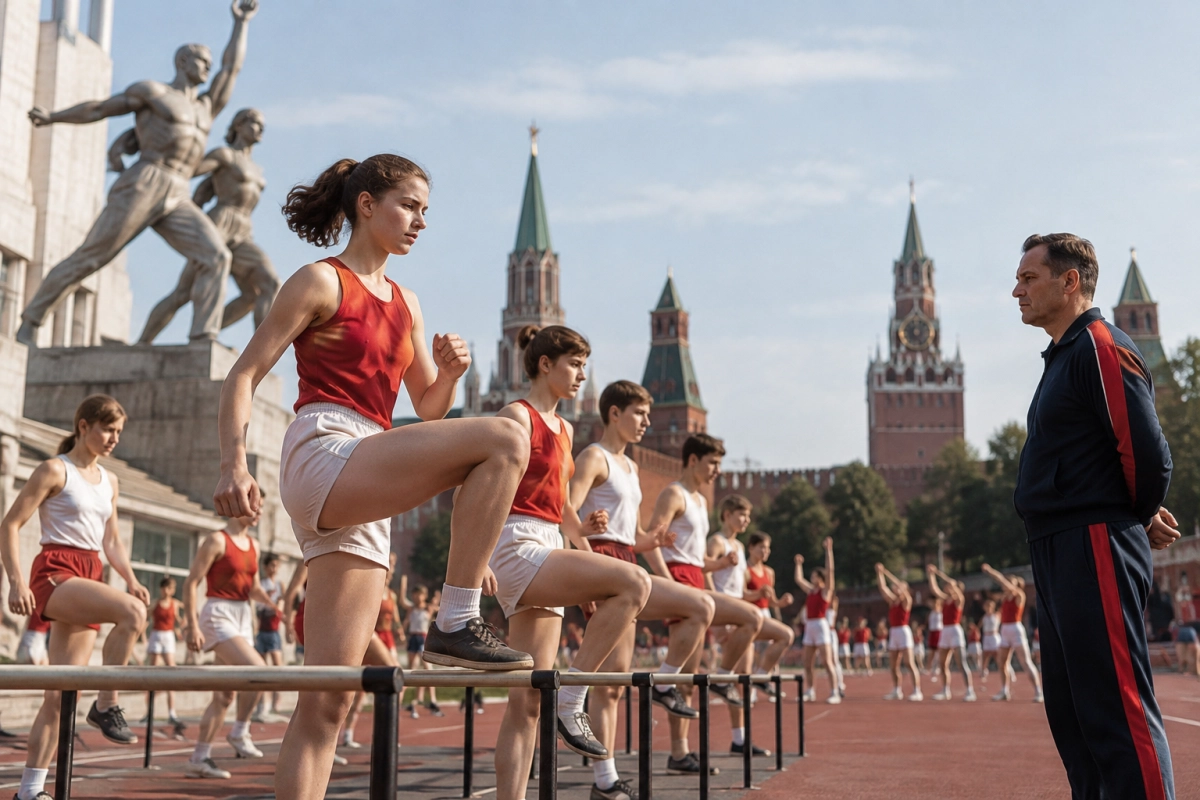
Long before a Russian gymnast steps onto a mat or a hockey prospect laces up skates for the first time, a vast administrative machine has already decided how that talent will be found, trained, and funneled toward the top. This is the defining feature of ruski sport across generations: it was never left to chance, private clubs, or family wealth. It was engineered, deliberately and systematically, as an instrument of the state. Understanding modern Russian athletic achievement — and the controversies now surrounding it — requires going back to the architecture built in the Soviet era, much of which still operates, largely unchanged in spirit, today.
The Soviet Union did not simply want winners. It wanted proof. Olympic medals, world records, and international dominance were treated as tangible evidence that the socialist model could outperform the capitalist West in every measurable sense, including the human body. That ideological mission required infrastructure capable of scanning an entire population for physical talent and developing it with industrial efficiency.
The DYUSSH Network and the Talent Pipeline
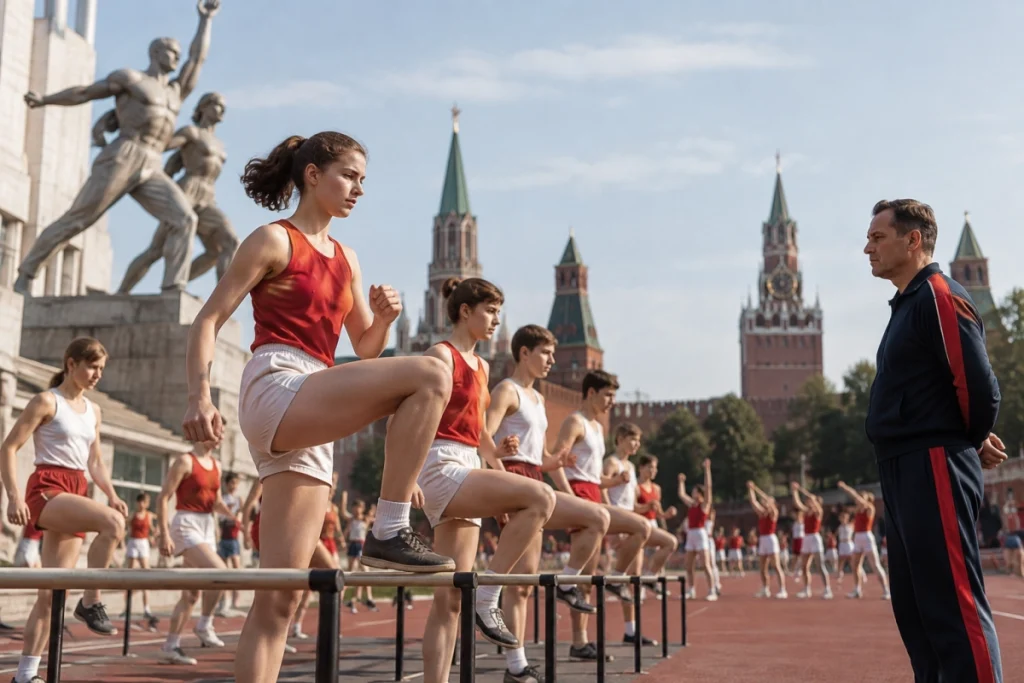
At the center of this infrastructure sat the DYUSSH system — the Children and Youth Sport Schools that spread across Soviet cities, factory towns, and military garrisons. These were not extracurricular programs in the Western sense. They were specialized institutions, often attached to larger sports societies, designed to identify promising children early and move them through standardized, state-supervised training tracks.
A child showing aptitude in gymnastics, swimming, or athletics could be pulled into this system well before adolescence, assigned coaches, monitored for physical development, and promoted or filtered out based on performance benchmarks. The approach resembled a funnel: thousands entered at the base, and a comparatively small number emerged at the elite level, but those who did had already logged years of structured, state-funded preparation before facing international competition.
This pipeline model solved a problem that many Western nations never had to confront in the same way, since private clubs, university scholarships, and family-funded coaching dominated talent development elsewhere. In the USSR, sport was treated as a public good and a strategic resource, meaning funding flowed from the center outward, rather than depending on local wealth or parental investment.
Dynamo, CSKA, and the Military-Security Roots of Elite Clubs
Parallel to the youth schools, a second layer of institutional power took shape in clubs tied directly to the state’s security and military apparatus. Dynamo, founded in 1923 under the sponsorship of the Soviet political police, grew into a sprawling sports society with thousands of facilities and dozens of its own youth schools by the early 1970s. CSKA, meanwhile, developed as the sporting wing of the armed forces, giving the military a direct stake in producing champions.
These were not ordinary clubs competing for trophies. They were extensions of state institutions, with athletes often formally enlisted as soldiers or security personnel, drawing salaries and benefits in exchange for their athletic service. The result was a closed, self-reinforcing ecosystem in which the state recruited, employed, trained, and showcased its own athletes through structures it directly controlled.
That military-security foundation did not disappear with the Soviet collapse. It persisted, adapted, and in some respects hardened — a continuity that becomes increasingly important when examining how contemporary Russian sport has responded to isolation and international scrutiny in recent years.
Surviving the Collapse: Continuity Through the 1990s
When the Soviet Union dissolved in 1991, the logical expectation was that a system so thoroughly dependent on state subsidy would collapse along with it. Centralized funding evaporated almost overnight, coaches went unpaid for months at a time, and many of the sports societies that had underwritten Dynamo and CSKA’s regional branches found themselves without a patron. Yet the underlying architecture did not vanish. Facilities remained standing, coaching lineages remained intact, and the institutional habit of routing talent through state-linked channels persisted even as the money behind it thinned out.
What changed was not the structure but its funding source. Oligarchs, regional governors, and newly privatized industrial firms began stepping into gaps once filled by Moscow ministries, often sponsoring the very clubs and schools their Soviet predecessors had built. This created a hybrid system: nominally post-Soviet, but structurally almost identical to what came before, with the same emphasis on early identification, centralized coaching standards, and institutional ownership of athletic careers. Many coaches who had trained under strict Soviet protocols simply continued applying them, training the next generation of Russian competitors with methods inherited rather than redesigned.
Putin-Era Reinvestment and the Return of State Priority
By the early 2000s, as the Russian state stabilized financially and politically, sport reemerged as a deliberate instrument of national prestige, echoing its Soviet function almost precisely. Federal budgets for athletic development increased substantially, regional sports boarding schools received renewed investment, and figures within government openly framed Olympic success as a marker of national resurgence rather than mere athletic achievement.
The bid for and hosting of the 2014 Sochi Winter Olympics exemplified this logic at its most ambitious. Billions of dollars poured into infrastructure, training centers, and athlete support systems, with the explicit goal of showcasing a resurgent Russia on home soil. The medal table topped by the host nation was never going to be treated as a side effect; it was the entire point, consistent with a tradition stretching back to the ideological calculations of the 1950s and 1960s.
This reinvestment also revived the old pipeline logic at the grassroots level. Regional governors, eager to demonstrate loyalty and competence to Moscow, funneled resources into local DYUSSH-style programs, reviving talent-scouting practices that had atrophied during the lean 1990s. The federal government, in turn, used national sports federations to standardize coaching certification and training benchmarks across the country, reasserting central control over a system that had briefly fragmented along regional and commercial lines.
Military-Sport Integration in the Present Day
Today’s CSKA and Dynamo clubs operate with far more commercial polish than their Soviet predecessors, fielding professional football and hockey teams that compete internationally and generate sponsorship revenue. But beneath that modern veneer, the institutional DNA remains recognizable. Athletes affiliated with these clubs still frequently hold formal ranks or ceremonial positions within military or security ministries, a practice that preserves the symbolic and financial link between sport and state power even as the surrounding economy has become ostensibly market-driven.
This enduring fusion matters enormously when Russian athletes face international suspension or exclusion, a recurring reality in the past decade. Because so much of the system’s funding, coaching infrastructure, and institutional loyalty still flows through state-linked channels, isolation from bodies like the IOC does not dismantle the pipeline — it simply redirects its output toward domestic and allied competitions, keeping the machine running at reduced but still functional capacity.
A Machine Built to Outlast Its Makers
What emerges from this history is not simply a story about medals or politics, but about institutional permanence. Systems designed to survive ideology outlive the ideology itself. The DYUSSH schools, the Dynamo and CSKA pipelines, and the coaching hierarchies built to serve a state that no longer exists in its original form have proven remarkably resistant to disruption, whether that disruption comes from economic collapse, political reinvention, or international sanction. Each time the surrounding context has changed, the architecture has simply found new sponsors, new justifications, and new audiences.
This is why suspensions from bodies like the International Olympic Committee have failed to produce the kind of structural reckoning many observers once predicted. Exclusion from a podium does not touch the deeper mechanism that produces the athletes standing on it. The pipeline was never built around any single competition or governing body; it was built around the idea that sport belongs to the state, and that talent, once identified, is a national asset to be cultivated regardless of who is watching.
Whatever shape Russian sport takes in the coming decade — reintegrated, further isolated, or redirected toward new alliances — the underlying logic is unlikely to change. It has already survived a revolution in reverse, a currency collapse, and a generation of international estrangement. A system built that durably was never going to be undone by a boycott. It was built to keep producing champions no matter who, in any given decade, is left in the room to applaud them.