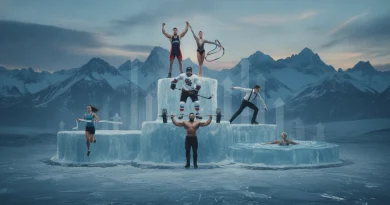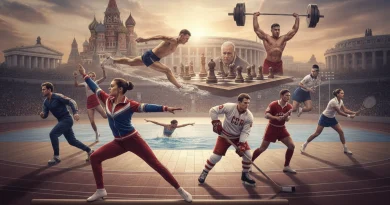
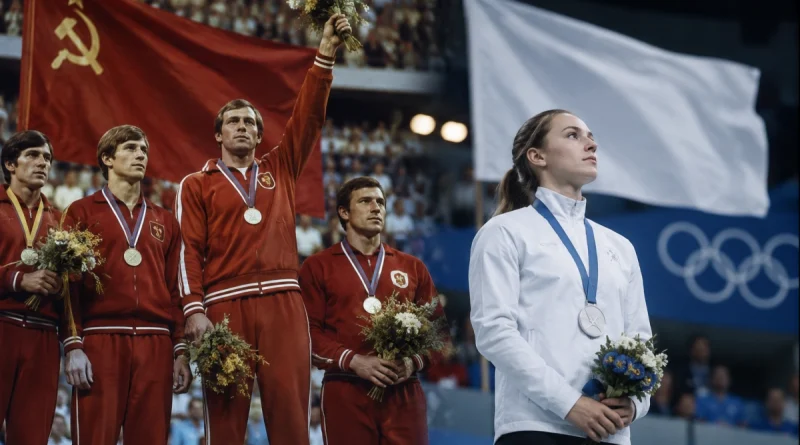
Olimpijski Šampioni Rusija: From Soviet Dominance to Neutral-Flag Reality
A Sporting Empire Built on Systematic Excellence
For much of the twentieth century, the Soviet Union treated Olympic success as a matter of national prestige rather than individual achievement. State-funded training academies, early talent identification, and a sports science apparatus unmatched anywhere in the world produced generations of athletes who dominated gymnastics halls, wrestling mats, and athletics tracks with a consistency that still shapes how historians discuss olimpijski šampioni Rusija today. This wasn’t accidental brilliance — it was infrastructure, ideology, and ambition fused into a single machine.
The results speak for themselves. Larisa Latynina, the Ukrainian-born Soviet gymnast, closed her career with nine gold, five silver, and four bronze medals, a haul that still makes her the most decorated female Olympian in history more than six decades later. Her longevity at the top of the medal table wasn’t an isolated case; it reflected a broader system in which gymnastics, wrestling, and athletics functioned almost as extensions of state policy, each discipline cultivated with the same rigor applied to the space program or military technology.
Wrestling and Athletics: The Quiet Backbone of Soviet Supremacy
While gymnastics captured global attention through artistry and grace, wrestling built the Soviet Union’s reputation through sheer dominance of technique and physical preparation. Freestyle and Greco-Roman wrestling became disciplines where Soviet, and later Russian, athletes were expected to win rather than merely compete. This tradition carried directly into the post-Soviet era, most visibly through Abdulrashid Sadulaev, whose Olympic titles in Rio 2016 and Tokyo 2020/21 placed him among the most feared competitors of his generation and reaffirmed that Russia’s wrestling pipeline had survived the collapse of the USSR largely intact.
Athletics told a more complicated story. Soviet track and field athletes routinely challenged American supremacy throughout the Cold War, but the post-Soviet transition introduced instability that gymnastics and wrestling largely avoided. Funding fractured across newly independent republics, coaching networks dispersed, and by the 2000s, doping scandals began eroding trust in results that had once seemed unimpeachable. Where wrestling maintained continuity, athletics became the discipline most exposed to the credibility crisis that would eventually engulf Russian sport as a whole.
Figure Skating’s Rise as the New National Symbol
As gymnastics and athletics faced varying degrees of institutional strain after 1991, figure skating quietly ascended to become Russia’s most emotionally resonant Olympic discipline. It combined artistic tradition with technical difficulty in a way that resonated domestically and internationally, producing champions who became household names far beyond sporting circles. The discipline’s cultural weight in Russia arguably now exceeds even gymnastics, a shift that becomes especially relevant when examining who is permitted to compete under neutral status in the current climate — a subject inseparable from the sanctions and vetting processes now defining Russian participation at the highest level.
Understanding how Russia arrived at this point requires tracing the individual careers that built its Olympic identity in the first place — beginning with the gymnasts whose records still stand unmatched decades after the Soviet Union itself ceased to exist.
The Gymnasts Who Defined an Era Before the Fall
Long before Latynina’s record became a benchmark cited in retrospectives, Soviet gymnastics had already established a template that later champions would refine rather than reinvent. Men’s gymnastics produced its own towering figures, with athletes like Nikolai Andrianov accumulating medal counts that rivaled Latynina’s in both volume and longevity. Andrianov’s fifteen Olympic medals across three Games demonstrated that Soviet dominance in the discipline wasn’t confined to one gender or one training center — it was a nationwide pipeline feeding talent from Moscow to the provinces, all funneled toward the same international stage.
What made this generation distinct from later Russian gymnasts wasn’t simply talent density but institutional permanence. Coaches worked within a system designed for multi-decade continuity, where a promising eight-year-old could be tracked, trained, and refined through a single unbroken pathway to Olympic selection. When the Soviet Union dissolved, that pathway didn’t vanish overnight, but it fractured into competing federations across Russia, Ukraine, Belarus, and other former republics, each inheriting fragments of a once-unified machine. The gymnasts who emerged from this transitional period — figures like Alexei Nemov in the 1990s and 2000s — succeeded not because the old system remained intact, but because enough institutional memory survived the collapse to produce one final generation of Soviet-trained excellence under a Russian flag.
The Doping Crisis and Its Long Shadow Over Legitimacy
No discussion of Russia’s Olympic champions can responsibly avoid the state-sponsored doping revelations that surfaced after the Sochi 2014 Winter Games. Investigations led by whistleblowers and international agencies exposed a systematic manipulation of drug testing that implicated officials at the highest levels of Russian sport, triggering years of shifting sanctions, stripped medals, and reconstituted results across multiple disciplines. The fallout didn’t merely tarnish individual reputations; it forced a reassessment of how much of Russia’s post-Soviet medal tally could be considered fully legitimate.
The consequences rippled unevenly across sports. Athletics, already weakened by the institutional fragmentation described earlier, bore the heaviest punishment, with entire teams barred from competing under the Russian banner for successive Olympic cycles. Wrestling and gymnastics, while not immune to scrutiny, largely escaped the blanket suspensions that crippled track and field, allowing their champions to continue competing — albeit under increasingly restrictive conditions — well into the 2020s.
Neutral Status and the New Rules of Olympic Participation
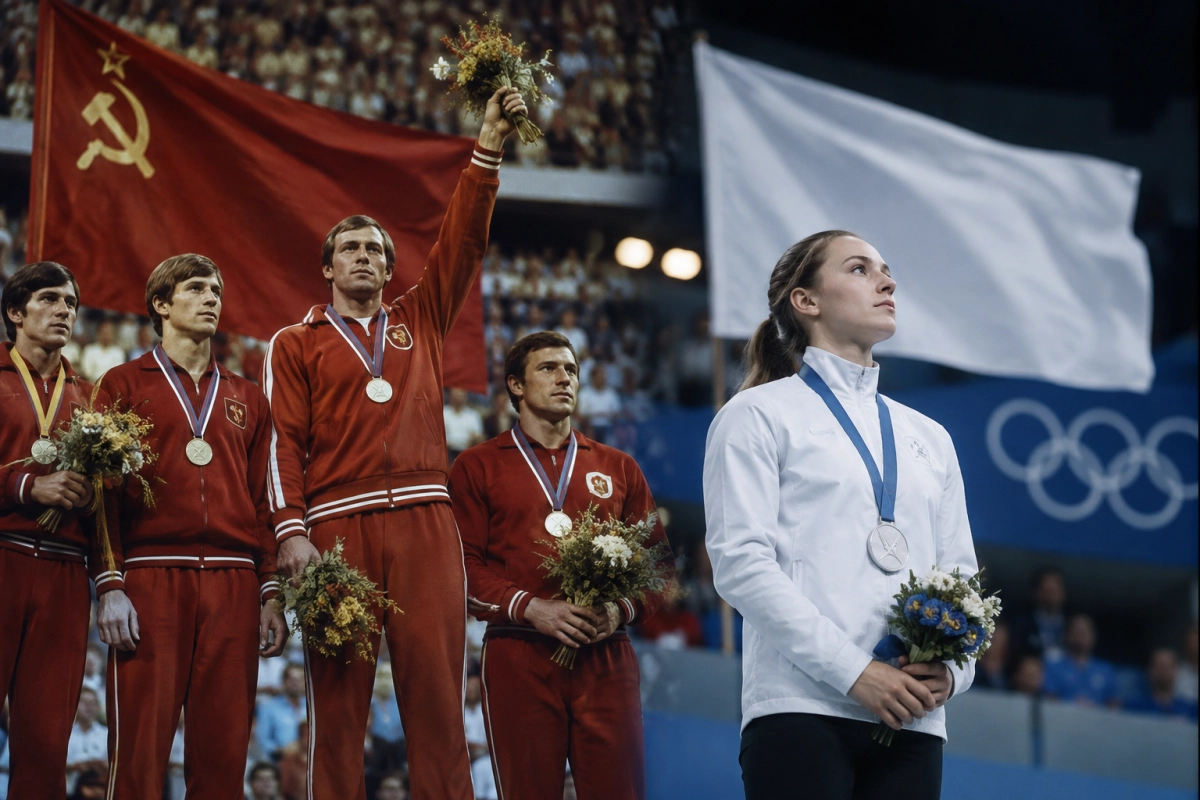
The geopolitical fallout following 2022 compounded an already precarious situation, layering sanctions related to international conflict atop existing doping-related restrictions. Russian athletes wishing to compete at the Olympic level now often do so only under strict neutrality provisions — competing without national flags, anthems, or team designations, and subject to vetting processes that assess individual conduct rather than simple eligibility. This arrangement has redefined what it even means to claim an Olympic champion as distinctly “Russian,” complicating historical comparisons between Soviet-era dominance and contemporary achievement in ways that continue to evolve with each Games cycle.
What Remains When the Flag Is Taken Away
Strip away the anthem, the flag, the medal-table nationalism that once defined how these achievements were counted, and what’s left is a body of individual performance that remains difficult to dismiss. Sadulaev’s technical mastery on the mat, Andrianov’s fifteen medals across three Games, the quiet precision of skaters trained in a system built long before neutrality provisions existed — none of it was manufactured by the apparatus that surrounded it, even if that apparatus provided the runway. The system built the pipeline; it didn’t perform the routines or win the bouts.
This is the tension that now defines any serious look at olimpijski šampioni Rusija: separating the machinery of state sponsorship, and later state-sponsored deception, from the athletes who trained within it and, in many cases, exceeded whatever the system expected of them. The doping revelations rightly demand skepticism toward results from certain years and certain federations, particularly in athletics. But applying that same skepticism uniformly across gymnastics, wrestling, and figure skating risks flattening a much more nuanced history into a single verdict it doesn’t deserve.
Where this leaves Russian Olympic sport going forward remains genuinely unsettled. Neutral status, individual vetting, and the ongoing entanglement of doping sanctions with geopolitical ones mean that future champions — if they’re permitted to compete at all — will be judged by criteria no Soviet-era athlete ever faced. Whether that produces a fairer accounting of merit or simply a different kind of politicization is a question the next several Olympic cycles will have to answer. For now, organizations like the International Olympic Committee continue to shape those terms case by case, leaving the full legacy of Russian Olympic dominance suspended between historical record and unresolved reckoning.
What’s certain is this: the medals already won, the records already set, and the athletes who earned them under whatever flag they carried at the time have already written themselves into Olympic history. The debate over how to interpret that history is far from finished — but the history itself no longer is.