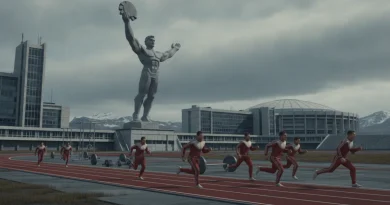

Behind the Medal: The Hidden Realities of Life as a Soviet Athlete

Athletes as Instruments of the State: The Soviet Sports Machine
When Soviet athletes stepped onto the podium at the Olympics, draped in red and gold, the world rarely saw everything that had brought them there — a system so total in its reach that the athlete as an individual had, in many ways, ceased to exist long before competition began.
The Soviet Union understood early that sport was not merely entertainment. It was geopolitical theater. Every gold medal was a referendum on communist superiority, every world record a rebuke to Western capitalism. This ideological framing shaped how athletes were identified, trained, monitored, and expected to think about themselves.
For the советски спортисти — the Soviet athletes who populated this machine — the experience was one of profound duality. On the surface, they were celebrated heroes granted privileges ordinary Soviet citizens could only imagine: better food, better housing, foreign travel. Beneath that surface, they lived under institutionalized control that penetrated even their private thoughts and personal relationships.
From Childhood Talent Scouts to State-Controlled Academies
The pipeline began young — sometimes disturbingly young. Soviet sports schools, known as sportivnye shkoly, operated across every republic, identifying talented children through systematic physical screenings. A child showing exceptional coordination or lung capacity could be redirected away from standard education and funneled into specialized training almost before they had the language to understand what was happening.
Once inside these academies, athletes entered a world structured entirely around performance. Coaches held enormous authority — not just athletic, but social and moral. Defying a coach’s directive carried implications that rippled outward into questions of ideological loyalty. Athletes learned quickly that compliance and excellence were not separate demands. They were the same demand.
The state invested heavily in sports science and physiology at a time when Western programs were far less systematic. But that sophistication existed in a context stripped of individual agency. Doping programs — later subjects of major international controversy — were in many instances administered without the athlete’s full understanding or meaningful consent. The body was state property, optimized for state purposes.
KGB Oversight and the Surveillance of Success
Foreign competition meant foreign exposure, making successful athletes a security concern as well as a national asset. The KGB maintained active oversight of sports delegations abroad, embedding informants within teams and monitoring athletes’ interactions with foreigners. Every conversation at an international tournament carried potential weight.
This surveillance also operated inward, shaping the culture of training groups. Trust between teammates was complicated by the awareness that any one of them might be reporting. The psychological environment this created — one of permanent, low-grade vigilance — is something former Soviet athletes have described across memoirs and interviews with striking consistency.
The Psychological Architecture of Ideological Performance
There is a particular kind of pressure with no precise Western equivalent — the pressure of competing not as yourself, but as a symbol. Soviet athletes were expected to win correctly, to embody through their performance the moral superiority of a system in which, publicly at least, they were required to believe. The performance happened twice: once on the track or the ice, and once in every interview, every press conference, every encounter with a foreign journalist.
Former Soviet athletes describe a learned instinct for self-editing that became second nature over years of conditioning. What you said about your training, your coaches, your living conditions — all of it was filtered through an awareness of what the correct answer was. Not lying, exactly. Something more insidious: a gradual internalization of the acceptable narrative until the boundary between performed belief and genuine belief became genuinely difficult to locate.
Sports psychologists within the Soviet system were not primarily concerned with managing competitive anxiety. Their mandate was more ideological — reinforcing commitment and cultivating what was described as the proper volia, or will, a concept fusing athletic determination with political steadfastness. The inner life of the athlete was not private territory. It was another domain to be optimized.
Defection, Loyalty, and the Cost of Leaving
The defections that did occur threw the system’s contradictions into sharp relief. When a celebrated athlete chose to remain in the West, the state’s response was swift and punitive. Families left behind faced professional consequences. The defector’s name was scrubbed from official records. Teammates closest to the defector sometimes found themselves under heightened suspicion simply by proximity.
This climate meant that even athletes who privately harbored doubts had powerful incentives to suppress them. Collective punishment converted personal loyalty into something closer to hostage compliance. Athletes understood that their behavior abroad reflected not only on themselves but on everyone connected to them at home.
What makes this particularly complex is that many Soviet athletes genuinely felt pride in representing their country. Patriotism and coercion were not always cleanly separable. The system cultivated real emotional investment alongside its mechanisms of control, which made later reckonings — in memoirs, in post-Soviet interviews — often ambivalent and resistant to simple narratives of victim and participant.
The Body as Political Property: Doping and Consent
No honest account of the Soviet sports machine can avoid the doping programs that ran through it, and no honest account can treat them as simply a matter of cheating. The ethical dimensions were far darker.
Athletes were administered performance-enhancing substances as part of standardized medical protocols. Some knew what they were receiving. Some were told the substances were vitamins or recovery aids. Some were young enough, and sufficiently conditioned to unquestioning compliance, that asking what was in the injection felt unauthorized. Informed, freely given consent was structurally incompatible with the hierarchy in which these athletes existed.
The long-term health consequences were significant. Hormonal disruption, cardiovascular damage, and other chronic conditions have been documented among former Soviet-era competitors across multiple sports. These consequences arrived after the medals and the anthems, after whatever political utility their bodies had served had been fully extracted. The state that had optimized them offered little in the way of ongoing care or acknowledgment.
After the Anthem: What the Soviet Athletic Experience Left Behind
The Soviet sports machine did not simply end when the Soviet Union did. It dissolved unevenly, leaving behind athletes formed entirely within its logic who were now expected to navigate a world operating by entirely different ones. Some transitioned into coaching, carrying elements of the old system into post-Soviet and Western contexts. Others found themselves adrift, their identities so thoroughly constructed around athletic function that retirement felt less like freedom than erasure.
Memoirs published in the 1990s and 2000s by former Soviet competitors tend to share a particular emotional register: neither straightforwardly resentful nor naively nostalgic, but genuinely uncertain about experiences that contained real excellence and real exploitation in proportions that resisted easy separation. The fact that these athletes had achieved extraordinary things within a system that treated them as instruments did not cancel the achievement. But it complicated it, permanently.
What the Soviet athletic model ultimately revealed — and what its legacy continues to surface in debates about state sport programs worldwide — is the tension that exists wherever athletic performance becomes a vehicle for something beyond sport itself. When medals are required to mean more than athletic excellence, the athlete is always asked to carry a weight no human performance can indefinitely bear.
For scholars, historians, and anyone genuinely interested in the intersection of power, the body, and political ideology, the Soviet sports system remains one of the most instructive case studies of the twentieth century. The Olympic Studies Centre holds extensive documentation on the geopolitical dimensions of Cold War sport that provides essential context for understanding how these systems operated within the broader international competition of the era.
The athletes who wore that red and gold were neither the pure heroes the Soviet state required them to be nor the simple victims that retrospective condemnation sometimes renders them. They were people — talented, pressured, surveilled, medicated, celebrated, and ultimately expendable — who performed at the highest levels under conditions most of us will never be asked to imagine. That complexity is the most honest thing we can offer them now, and perhaps the most deserved.