The Greatest Russian and Soviet Athletes of All Time: A Cross-Sport Retrospective
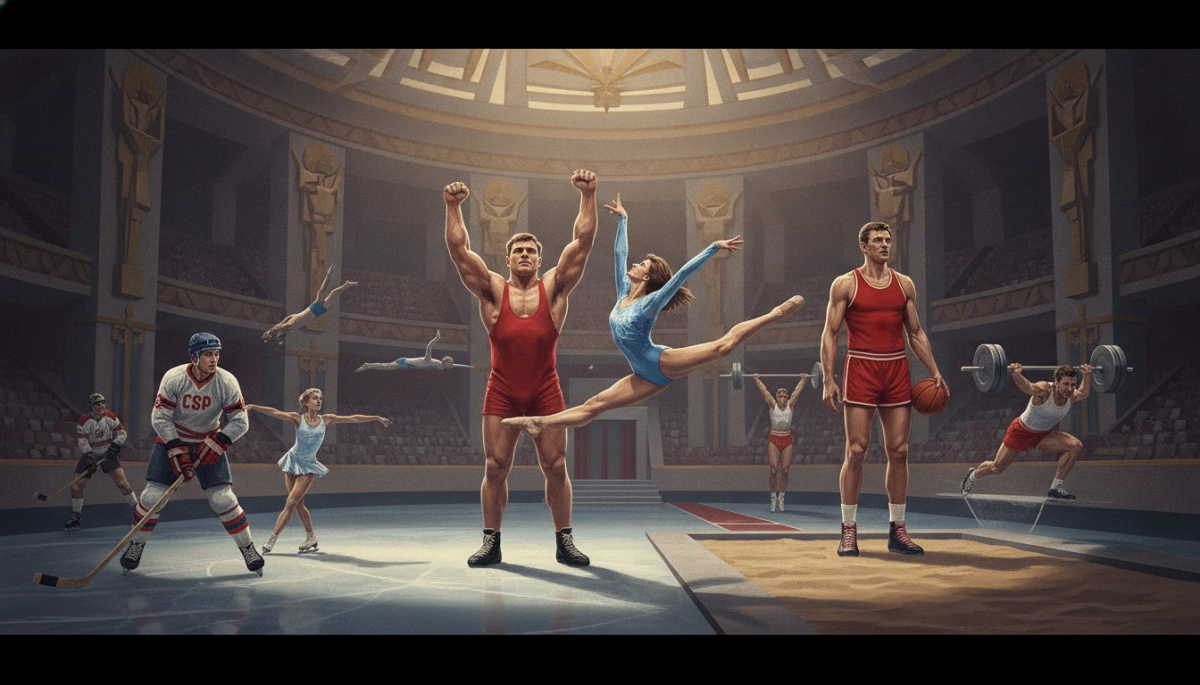
A Sporting Empire: How Russia and the Soviet Union Shaped Athletic History
No nation’s sporting legacy demands quite the same reckoning as that of Russia and the Soviet Union combined. Across more than a century of competitive sport, athletes from this vast territory didn’t merely win — they redefined what winning looked like. They broke world records in cold gymnastics halls, lifted extraordinary weights in packed arenas, and played hockey with a precision that made North American scouts question everything they knew about the game.
The Soviet sports machine was, by design, a projection of ideological power. Success at the Olympics wasn’t celebrated as individual achievement — it was framed as evidence of a superior social system. Athletes trained under state-sponsored programs that filtered talent from childhood, channeling it into disciplines where dominance would be most visible. Gymnastics, weightlifting, athletics, chess — these were strategic priorities, not casual pursuits.
With the collapse of the USSR in 1991, that infrastructure fractured, but the talent pipeline didn’t disappear. Russia continued producing world-class competitors — tennis players who dominated grand slams, hockey players who reshaped NHL franchises, footballers who brought technical elegance to European leagues. The thread connecting Soviet giants to modern Russian stars runs through coaching traditions, physical culture institutions, and a deeply embedded national belief that sport carries real weight.
Measuring Greatness: Why This Ranking Goes Beyond Gold Medals
Any serious attempt to rank the najbolji ruski sportisti — the greatest Russian and Soviet athletes — immediately runs into a problem of criteria. A gymnast with nine Olympic gold medals occupies a different cultural space than a chess grandmaster who became a Cold War symbol without ever entering a stadium. Both matter. The question is how.
This retrospective uses two intersecting measures. The first is competitive achievement: breadth and consistency of performance, the difficulty of the era, and the strength of opposition faced. The second is cultural significance — the degree to which an athlete transcended their sport to become part of the larger national narrative.
It’s also worth clarifying what “Russian” means here. Many athletes examined competed under the Soviet flag, representing a multinational state. Their inclusion reflects the historical and cultural continuity that Russia itself has always claimed with the Soviet sporting tradition.
- Competitive achievement across multiple seasons or tournaments
- Global recognition and influence on their respective discipline
- Role in shaping national sporting identity, whether Soviet or post-Soviet Russian
- Cultural resonance beyond the immediate sporting context
The Soviet Sports Machine: A System Built to Produce Legends
The Soviet model of athletic development was unlike anything the Western world had constructed — not because of any single innovation, but because of its totality. Sport was embedded into the state apparatus with the same seriousness applied to industrial production or military readiness. Young athletes identified as promising were relocated to specialized schools where their days were structured entirely around performance development.
This system produced extraordinary technical refinement. Soviet gymnasts didn’t simply execute routines — they pioneered them. Elements now considered foundational to the sport were invented and first performed by athletes whose names remain attached to those movements in international rulebooks. The same pattern repeated in weightlifting, where Soviet coaching methodologies are still studied and adapted worldwide.
But the machine also imposed pressures that distorted individual stories in ways only visible after the Soviet period ended. Athletes who defected spoke of training environments that left no room for personal ambition separate from collective purpose. The greatest Soviet athletes navigated this tension with varying degrees of agency, and understanding it is essential to understanding why their achievements carry the weight they do.
What Changed After 1991 — and What Didn’t
The dissolution of the Soviet Union didn’t produce a clean break in athletic culture so much as a prolonged, uneven transition. Russia, as the largest and best-resourced successor state, inherited the bulk of the infrastructure along with the institutional memory of how to deploy it.
What shifted was the relationship between athlete and state. Post-Soviet Russian athletes competed with financial motivations that simply hadn’t existed before. Tennis players pursued ranking points and endorsement deals. Hockey players negotiated NHL contracts. This commercialization didn’t diminish the quality of competitors, but it fundamentally altered the frame around achievement. A Russian tennis player winning Wimbledon in the 2000s wasn’t making an ideological statement — or at least, not consciously.
What persisted was the coaching culture and its underlying philosophy: technical mastery over raw athleticism, delayed specialization until foundational movement patterns were deeply ingrained, and the integration of periodization into long-term planning. These threads ran continuously from the Soviet era into modern Russian sport, showing up in unlikely disciplines long after the structures that created them had dissolved.
The Icons Who Defined an Era
Certain figures in Russian and Soviet sporting history occupy a category beyond decorated. They became mythological — larger than the sport, larger than any single moment. What distinguishes the athletes at the very top of this retrospective isn’t simply volume of success. Several factors consistently reappear among the most significant names:
- The ability to perform under intense geopolitical scrutiny, where every competition carried meanings beyond sport
- A capacity to innovate within their discipline rather than simply execute what predecessors had established
- Longevity of dominance that outlasted the typical competitive window for their sport
- An international profile that extended into countries with no particular affinity for the Soviet or Russian cause
The Athletes Who Rose Above the System That Made Them
Any honest retrospective eventually arrives at the same recognition: the most enduring figures weren’t simply products of the state apparatus that trained them. The system could identify talent, concentrate resources, and eliminate distractions. What it could not manufacture was the capacity to define the terms of competition itself.
Larisa Latynina spent eighteen years in gymnastics, collected nine Olympic gold medals across two Games, and set a record that stood for nearly half a century until Michael Phelps surpassed it in 2012. But what made Latynina significant beyond the medal count was her role in establishing Soviet gymnastics as the aesthetic and technical standard against which every subsequent generation measured itself. She wasn’t chasing a tradition. She was building one.
Valery Borzov’s sprint dominance at the 1972 Munich Olympics carried particular charge, arriving when American supremacy in the short sprints was considered close to a natural law. His gold medals in the 100m and 200m were received in the United States as an affront, and in the Soviet Union as confirmation of what the system had always promised. That tension between individual achievement and political framing captures something essential about competing under the Soviet banner at the height of the Cold War.
Then there is Garry Kasparov, perhaps the most complex case in this retrospective. Chess sits at the edge of what most people classify as sport, yet the psychological demands Kasparov faced across decades of competitive play rival anything encountered in a stadium. His 1985 ascent to the world championship, defeating the legendary Anatoly Karpov in a match carrying unmistakable political undercurrents, and his subsequent twenty-year hold on the world number one ranking, constitute a record of sustained dominance with few parallels in any discipline. That he later became a prominent political dissident only deepened the complexity of his relationship to the national identity his success had once been used to celebrate. His complete game archive at ChessGames.com remains one of the most extraordinary records of sustained competitive excellence in sporting history.
The hockey tradition deserves its own acknowledgment. The Soviet national team of the late 1960s through the 1980s — anchored by Vladislav Tretiak, Valeri Kharlamov, and later Igor Larionov — played a brand of hockey so tactically sophisticated it functioned almost as a philosophical statement about how team sport could be organized. The 1972 Summit Series against Canada, which the Soviets were widely expected to lose decisively, ended in a narrow Canadian victory that permanently altered how the game was coached and understood in North America. The Soviets didn’t win that series. But they changed it.
Post-Soviet Russian sport added new dimensions without displacing the older ones. Maria Sharapova’s five Grand Slam titles brought market-driven, individually branded visibility the Soviet model never anticipated. Yelena Isinbayeva’s consecutive world pole vault records, set with methodical consistency, connected back through the technical tradition even as the context around them had transformed entirely.
What Endures When the Scoreboard Goes Dark
The final measure of any athlete’s significance isn’t the medal tally or the world records that may eventually be surpassed. It’s whether they altered the understanding of what their discipline could be — whether they moved the frontier rather than simply approached it.
By that measure, the Russian and Soviet sporting tradition has produced an unusual concentration of genuinely transformative competitors. Not because the system guaranteed it, but because certain individuals, working within and sometimes against the structures that shaped them, performed at levels that permanently changed what the rest of the world believed was possible.
That is the thread connecting Latynina to Kasparov, Tretiak to Sharapova, the Soviet weightlifting halls of the 1950s to the track surfaces of the 2000s. Across disciplines and political eras, the highest-achieving Russian and Soviet athletes shared something more durable than a flag: an orientation toward their craft that treated excellence not as an outcome to be achieved, but as a standard to be continuously redefined. The full weight of that legacy, complicated and contested as it remains, belongs to sporting history at the highest level — and it isn’t finished yet.