Russian Tennis: From Soviet Sports Schools to Grand Slam Glory
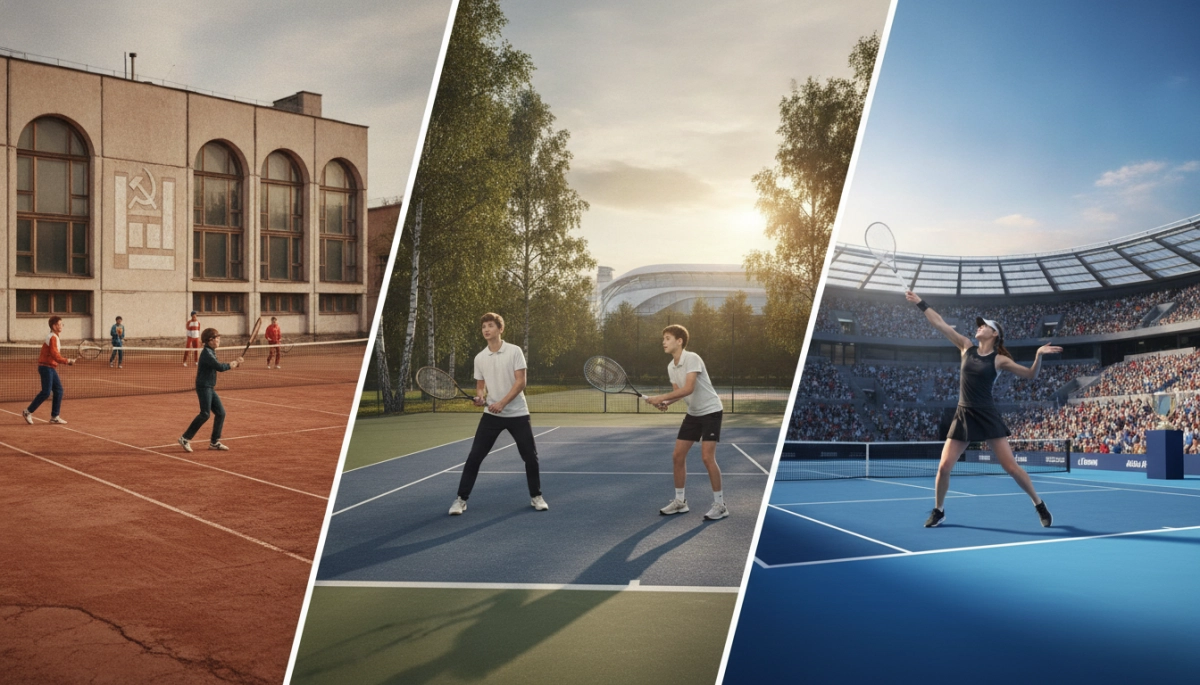
How the Soviet Sports Machine Planted the Seeds of a Tennis Nation
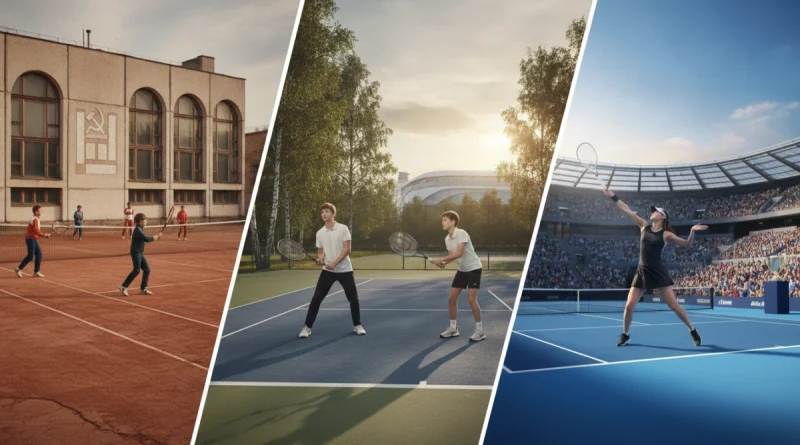
Long before Daniil Medvedev lifted a Grand Slam trophy at the US Open, Russian tennis was being quietly constructed inside Soviet sports schools. The Детско-юношеские спортивные школы — youth sports schools known as ДЮСШ — formed the backbone of Soviet athletic development across dozens of disciplines. Tennis was never the headline act; football, athletics, and hockey commanded far greater prestige and funding. Yet the infrastructure was there: disciplined coaching, early talent identification, and a culture that treated sport as a national project rather than a personal ambition.
That foundation proved more durable than the Soviet Union itself. When the USSR collapsed in 1991, state funding largely evaporated overnight. Academies scrambled, coaches emigrated, and Russian sport entered a painful institutional vacuum. Tennis survived precisely because it could attract private sponsorship and operate internationally with relative ease. Young players left for Western academies, families invested privately in coaching, and within less than a decade Russia was producing champions.
The Golden Generation: Kafelnikov, Safin, and the Women Who Rewrote the Record Books
Yevgeny Kafelnikov was the first to signal what was coming. His French Open title in 1995 and a second Grand Slam at the 1999 Australian Open announced Russia as a legitimate contender. Then came Marat Safin — ferociously talented and equally unpredictable — who claimed two Grand Slam titles and briefly reached world No. 1.
But it was the women who truly defined Russia’s golden era. Maria Sharapova, Svetlana Kuznetsova, and Dinara Safina collectively accumulated Grand Slam titles and world No. 1 rankings, placing Russian tennis at the center of the global game. Sharapova alone won five major titles across all four Grand Slam surfaces. Notably, none of these women developed professionally inside Russia. Sharapova trained at the Bollettieri Academy in Florida; Kuznetsova and Safina based themselves in Spain. Among the most followed ruski teniseri of that period, international exposure was less a luxury than a necessity.
This reveals something important about Russian tennis development during that era: a country with deep athletic tradition but inconsistent domestic infrastructure, producing world-class players by exporting them. The talent pipeline was real. The finishing environment, for a time, was not.
The Quiet Years and the New Wave: How Russia Rebuilt Its Men’s Game
The gap between Safin’s second Grand Slam title and Medvedev’s first was almost exactly fifteen years. That stretch was not barren — Nikolay Davydenko reached world No. 3 and won multiple Masters titles — but it lacked transcendent moments. Davydenko was in many respects the perfect illustration of the problem: a player of tremendous consistency who never accumulated the cultural weight his results deserved, quietly piling up titles while remaining invisible to casual audiences outside Russia.
What changed, gradually and then suddenly, was the domestic infrastructure itself. Private academies emerged in Moscow and St. Petersburg during the mid-2000s, better funded and more sophisticated than anything the late Soviet period had managed. The Russian Tennis Federation invested more systematically in talent identification and coach development. Crucially, the pathway shifted: rather than exporting teenagers raw to Western academies, Russian programs began retaining players longer domestically before sending them abroad with a more complete technical foundation.
Daniil Medvedev and Andrey Rublev represent that cohort almost perfectly — two players who came through Russian development systems, sharpened themselves on the European circuit, and arrived at the tour’s highest level with a technical seriousness that felt distinctly old-school even as their games were thoroughly modern. Medvedev brought something almost algorithmic to his tennis: a relentless baseline game, exceptional reading of angles, and mental composure that looked unnatural in someone so young. His 2021 US Open title, where he defeated Novak Djokovic in straight sets to deny the Serb a calendar Grand Slam, announced Russian men’s tennis to a new global audience with unmistakable force.
Playing Under a Flag and Without One: Geopolitics at the Net
The Russian invasion of Ukraine in February 2022 fundamentally altered the conditions under which Russian players compete internationally. Wimbledon banned all Russian and Belarusian players outright for 2022. The ATP and WTA tours took a different approach: players were permitted to continue competing but were required to do so as neutral athletes, stripped of national identity.
For athletes whose development had been framed around national pride and collective achievement, the neutrality requirement was not simply an administrative inconvenience — it removed a layer of identity woven into how they understood their own success. The practical constraints were significant:
- They compete without the visible backing of a nationally recognized federation.
- Davis Cup and Billie Jean King Cup participation has been suspended, removing team competition entirely.
- Some Western sponsors have reassessed endorsement deals.
- Travel logistics, banking access, and visa processing have all become more burdensome.
Medvedev navigated this period with characteristic composure, offering careful public statements that avoided political controversy. Rublev was more emotionally direct: at the 2022 Dubai Open, days after the invasion began, he wrote “No war please” on a camera lens after a match victory — a gesture widely noted precisely because it was so unusual given the implicit pressure on Russian athletes abroad.
The Question of Complicity and the Limits of Sport’s Neutrality
The debate around Russian athletes competing internationally is, at its core, a debate about what sport can and should do in response to state violence. Critics argue that allowing Russian players to compete — even without a flag — normalizes the situation. Supporters counter that individual athletes cannot be held responsible for government decisions made in Moscow. Neither position is fully satisfying, and tennis governing bodies have acknowledged this through inconsistent policies across tournaments. What the situation has produced is a generation of players who are simultaneously among the most scrutinized athletes in their sport and the most politically constrained — visible on every major stage, yet denied the straightforward national narrative that has historically accompanied that visibility.
What Endures: Russian Tennis Beyond the Political Storm
What the full arc of Russian tennis reveals — from the ДЮСШ classrooms of the Soviet era to Medvedev’s calculating baseline game on the world’s biggest courts — is a sporting culture with remarkable structural resilience. It survived the collapse of the state that built it, the exodus of its best coaches, the defunding of its academies, and a decade of anonymity in men’s tennis. It emerged with a generation of players capable of competing at the very top of a sport more physically demanding and tactically complex than it has ever been.
The geopolitical pressures shaping the careers of Medvedev, Rublev, and their contemporaries are real and should not be minimized. Competing without a flag is not a neutral act — it is an absence that carries meaning. The suspension of team competitions has severed a connection to collective national identity that mattered deeply to players and domestic audiences alike.
Yet none of this has stopped Russian tennis from producing elite competitors. Mirra Andreeva, born in 2007, reached the French Open semifinals while still a teenager, signaling that the talent pipeline is not merely intact but actively generating the next wave. The domestic academy infrastructure continues to operate. The machinery, however imperfect, is still running.
What remains genuinely unresolved is the question of legacy. Inside Russia, these players are national heroes whose achievements are framed entirely within a domestic narrative. Outside Russia — particularly in countries directly affected by the conflict in Ukraine — their continued presence on tour remains a source of genuine discomfort. These two realities exist simultaneously and show little sign of converging.
For the players themselves, the only available answer has been to keep playing — to let the tennis speak when the political situation offers no clean language. It is a continuation of something deeply embedded in Russian sporting culture from the beginning: the belief that athletic excellence is its own argument, capable of outlasting the systems that produce it and the crises that surround it. Whether that holds through the years ahead will depend on forces far beyond the baseline. But Russian tennis has already demonstrated a capacity for survival that few anticipated and fewer can fully explain. The International Tennis Federation continues to monitor the situation, but the courts, in the end, keep their own record.