Russian Tennis: From Soviet Sports Schools to a Global Power
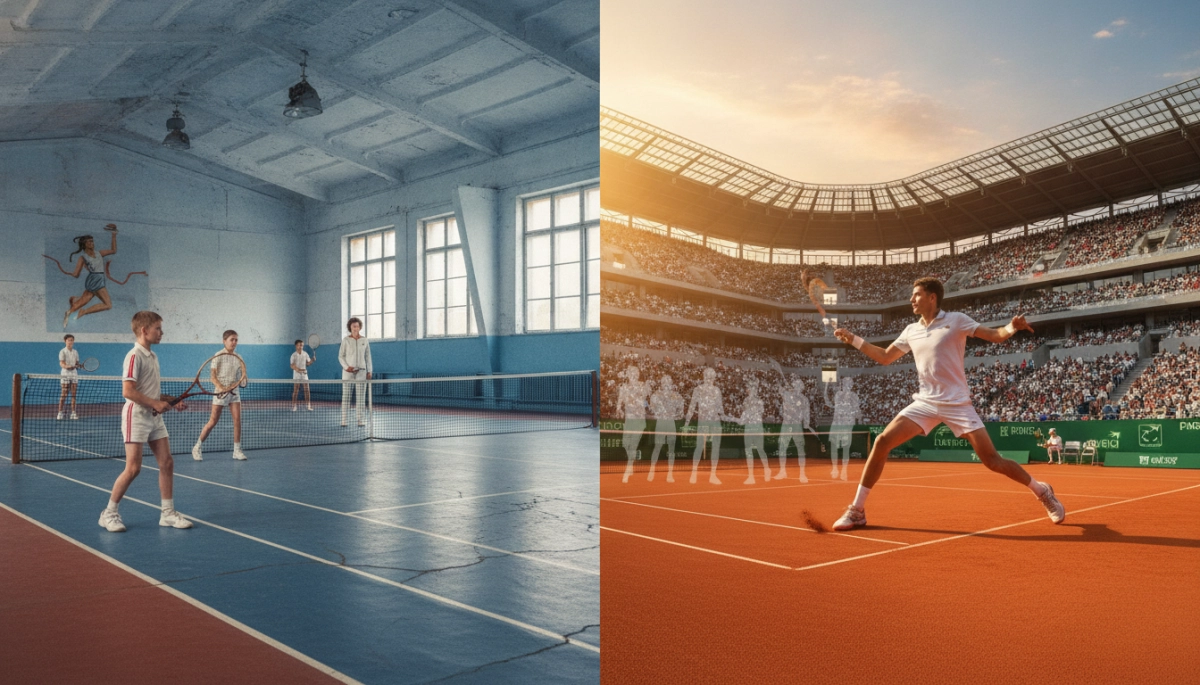
How the Soviet System Planted the Seeds of a Tennis Revolution
Long before Marat Safin was smashing rackets on Centre Court or Maria Sharapova was dominating Wimbledon, the foundations of Russian tennis were being laid with remarkable methodical precision. The Soviet Union was never a tennis powerhouse in the way it dominated gymnastics or athletics — but it built something arguably more durable: a national infrastructure for elite sport development that would outlast the USSR itself.
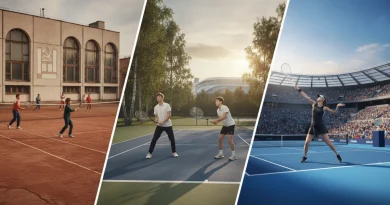
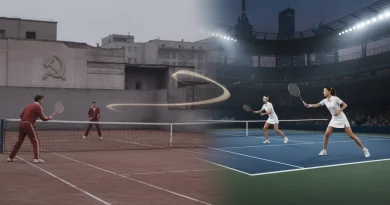
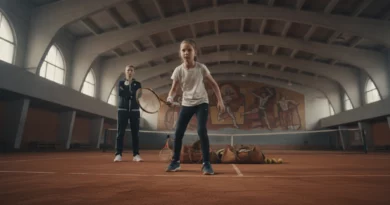
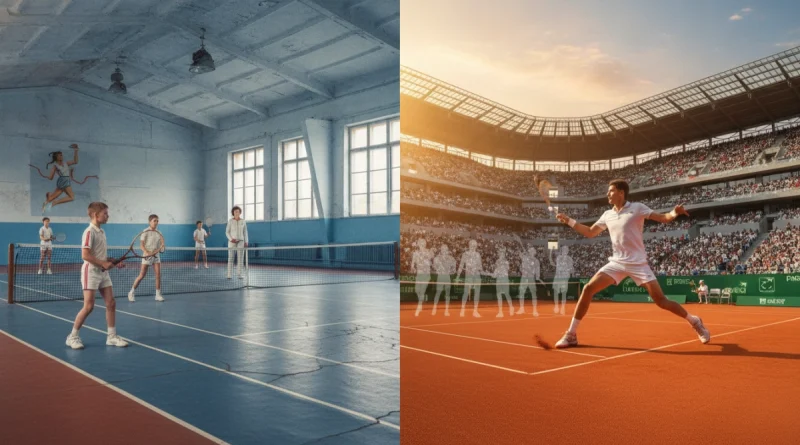
Soviet sports schools, known as sportivnye shkoly, operated on early identification and systematic coaching. Children showing athletic promise were streamed into specialized programs as young as five or six, trained under state-funded coaches with access to facilities most Western clubs couldn’t match. Tennis was a secondary priority, but it was still part of the system — and that mattered enormously when the Soviet Union collapsed and the infrastructure was partially privatized and inherited by coaches who understood both the discipline of the old model and the commercial possibilities of the new world.
What emerged in the 1990s was a hybrid model. Academies retained Soviet-era rigor while opening to Western investment. Young players were trained with an intensity that Western peers rarely experienced at the same age. Technique was drilled obsessively. Physical conditioning was non-negotiable. The psychological demands were significant.
The Golden Generation That Put Russian Tennis on the Map
The first decade of the 21st century belongs to Russian tennis’s golden generation. The concentration of Grand Slam talent was extraordinary. Marat Safin won the US Open in 2000 and the Australian Open in 2005. Anastasia Myskina became the first Russian woman to win a Grand Slam singles title at Roland Garros in 2004. Svetlana Kuznetsova followed within months, claiming the US Open. Then came Sharapova — Wimbledon champion at seventeen, eventually accumulating five major titles across all four Slams.
These weren’t isolated breakthroughs. They were the visible summit of a deep, well-populated pyramid. Russian players were filling the rankings, winning Fed Cup titles, and establishing their nation as one of the sport’s true powerhouses. What made this generation distinctive wasn’t just the number of champions but the diversity of their games. Safin played with explosive unpredictability. Kuznetsova combined physicality with clever court craft. Sharapova was defined by relentless baseline aggression and mental resilience. Together they represented a range of playing identities — proof the Russian system was producing complete athletes rather than tactical clones.
The Coaches Behind the Champions
Behind the golden generation stood coaches shaped by the Soviet system — people who understood long-term athletic development and could translate it into results on tour. These weren’t celebrity coaches parachuted in for visibility. Many were career educators who had spent decades within national programs, prioritizing technical precision above all else.
Sharapova’s story is illustrative. Her father moved the family to Florida so Maria could train at Nick Bollettieri’s IMG Academy — but the discipline she carried there wasn’t acquired on American soil. The ambition to sacrifice comfort for competitive excellence, to treat training as a serious professional endeavor before adolescence had properly arrived, reflected values transmitted from the Soviet sporting tradition, even without direct institutional ties to it.
Safin’s development told a different story. Trained partly in Spain under coaches who blended Western tactical thinking with his natural athleticism, his career illustrated that the pipeline wasn’t exclusively domestic. By the late 1990s, Russian talent was internationally mobile in a way the Soviet system had never permitted. Players could train abroad, compete on the junior circuit, and return home as national heroes without being confined to a single ideological framework — producing champions who were harder to categorize and, arguably, harder to defend against.
From the Spartak Tennis Club to a Global Phenomenon
Any serious account of Russian tennis must acknowledge the Spartak Tennis Club in Moscow, which functions as something close to the sport’s spiritual home in Russia. Its outdoor clay courts and modest facilities have launched more elite players than institutions with far greater resources could reasonably explain. What Spartak provided was consistency of coaching philosophy, a culture of competitive seriousness, and access to a peer group that pushed players to develop faster than individual training ever could.
The club became a symbol for the broader Russian tennis model: unglamorous inputs, elite outputs. It demonstrated that prestige infrastructure was never the real differentiator. The differentiator was the quality of the coaching relationship and the competitive environment surrounding a young player during their formative years. As tennis became commercially viable in post-Soviet Russia — driven partly by the visibility of its champions — private investment began flowing into clubs and academies across the country, with Spartak as its symbolic anchor.
Competing Under Neutral Flags — A New and Complicated Reality
The political fractures of the 2020s have introduced complexity that no previous generation of Russian players had to navigate. Following Russia’s invasion of Ukraine in 2022, tennis governing bodies moved to exclude Russian and Belarusian players from competing under their national flags. Wimbledon initially banned them outright before reversing that decision in favor of the neutral status policy adopted by the ATP and WTA.
The consequences for individual players have been significant. Daniil Medvedev and Andrey Rublev — the leading figures of Russia’s post-golden generation — have continued competing at the highest level, accepting constraints without public comment. Others have found the situation more personally disorienting, navigating press conferences in which their nationality is simultaneously their identity and something they are institutionally required to keep at arm’s length.
- Russian and Belarusian players currently compete without national identification on tour rankings and tournament draws.
- Prize money and ranking points continue to accumulate normally under the neutral status framework.
- Team competitions, including the Davis Cup and Billie Jean King Cup, remain inaccessible under current regulations.
- The policy is subject to ongoing review as the geopolitical situation evolves.
Medvedev, ranked world number one in 2022, spoke with visible discomfort about his position — neither fully included nor fully excluded, representing a sporting tradition with deep roots while being prevented from representing it by name. For Russian tennis, a tradition built on collective infrastructure and national pride, competing without a flag is more than a logistical adjustment — it is a fundamental disruption of the identity the entire pipeline was designed to produce.
A Tradition Too Deep to Be Defined by a Flag
What the arc of Russian tennis ultimately reveals is something that political decisions, however sweeping, cannot easily reach: the persistence of a sporting culture built across generations. The Soviet-era sports schools produced champions by design — through early specialization, relentless repetition, and the deliberate cultivation of mental toughness. Those qualities survived the collapse of the state that created them and proved remarkably transmissible across the decades that followed.
Medvedev’s composure under pressure, Rublev’s ferocious baseline game, the quiet professionalism of Karen Khachanov — these are not coincidences of individual talent. They are recognizable expressions of a tradition. The pipeline has changed its shape, absorbed private capital, moved players to academies across three continents, and learned to operate inside a commercial sport the original architects would barely recognize. But its essential character has remained coherent across fifty years of extraordinary political turbulence. The ATP singles rankings have reflected Russian presence near the top for more than two decades, and there is little structural reason to expect that to change regardless of how the geopolitical situation resolves.
The story of Russian tennis is, at its deepest level, a story about institutional memory — about what happens when a country invests seriously in long-term human development and refuses to let that investment dissolve even as everything around it changes. Empires end. Systems collapse. Flags get taken down. But the player taught to hit a backhand a thousand times before breakfast is still going to hit that backhand. The tradition endures in the body, in the habits, in the culture of seriousness that passes from coach to student across every generation. That is what the Soviet sports schools built, and that is what Russian tennis, for all the complications of its present moment, continues to carry forward.