
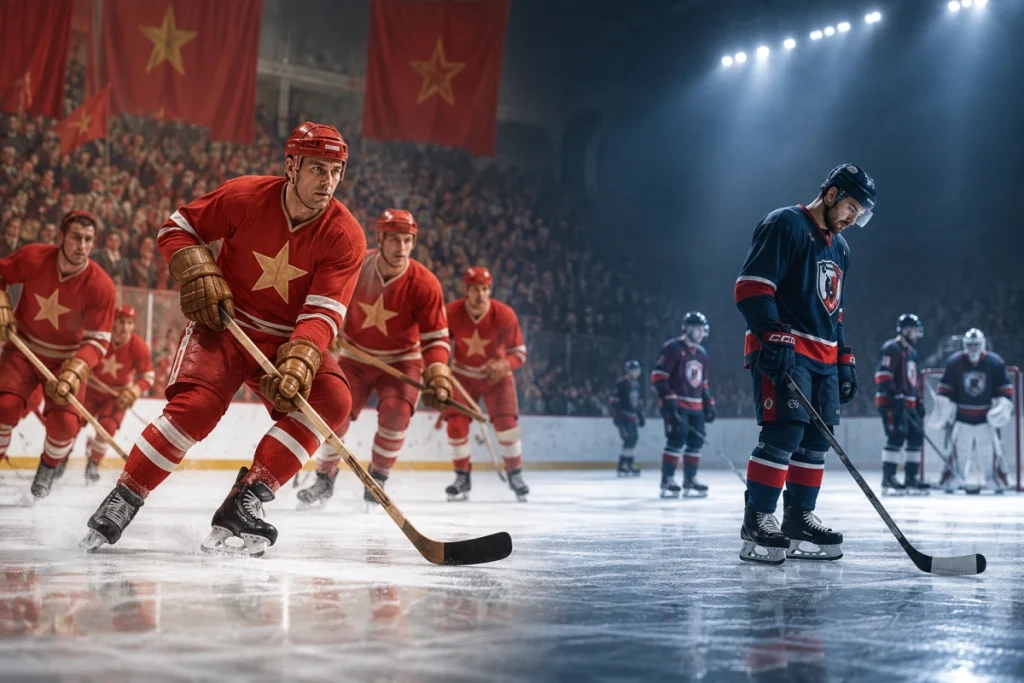
Russian Ice Hockey: From Red Army Dominance to KHL Isolation
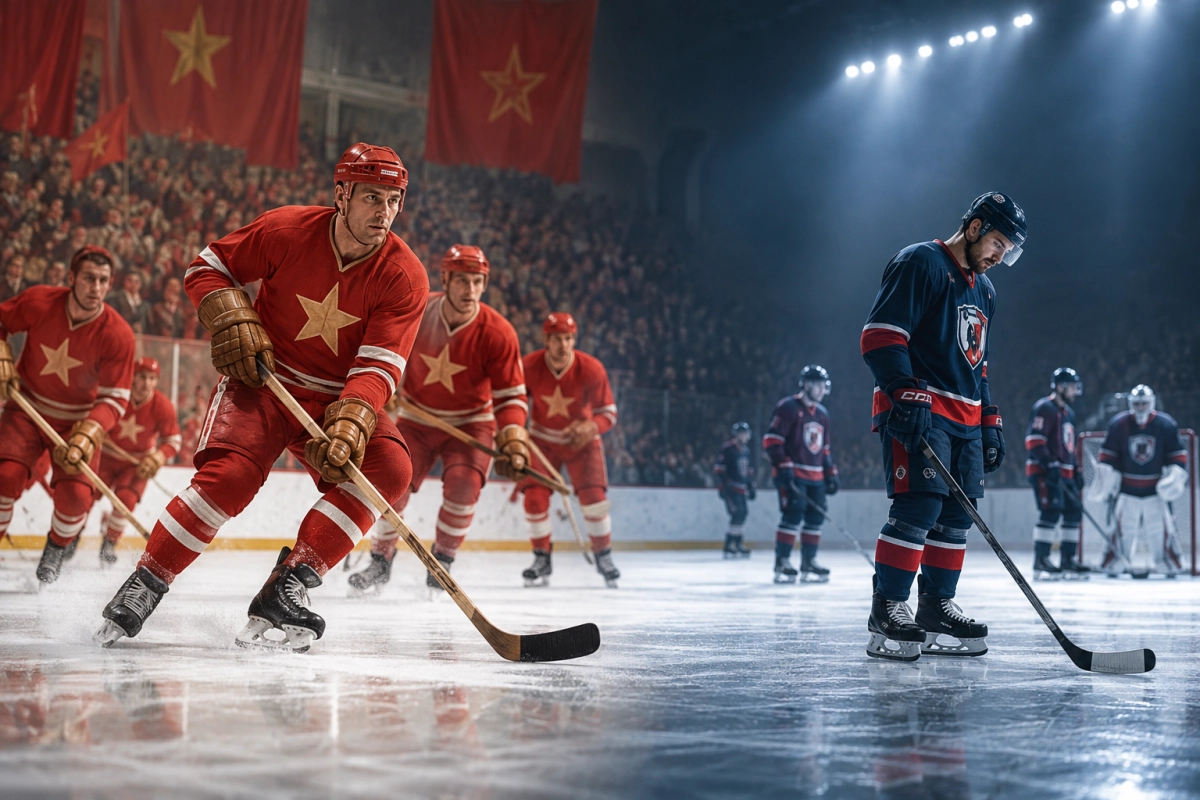
The Red Army Blueprint That Built a Hockey Empire
Long before Western audiences understood why Soviet teams seemed unbeatable, the architecture of that dominance was already in place. CSKA Moscow, known internationally as the Red Army club, functioned less like a traditional sports team and more like a state institution. Players lived under military discipline, trained year-round under a single coaching philosophy, and rarely left the program once selected into it. This continuity produced something rare in team sports: a style of play passed down almost genetically from one generation of skaters to the next.
The architect most associated with this system, Anatoli Tarasov, treated hockey as a chess problem rather than a physical contest. His teams emphasized puck possession, five-man unit cohesion, and constant lateral movement — principles that looked almost alien to North American scouts accustomed to dump-and-chase hockey. Because CSKA effectively served as the core of the Soviet national team, international tournaments became showcases for a club-level system refined over decades rather than a roster assembled for a single Olympic cycle.
Olympic Supremacy and the Weight of a National Identity
The results validated the method emphatically. Soviet teams, built almost entirely around CSKA personnel, turned Olympic hockey into a near-formality for two decades, interrupted memorably but rarely. That consistency transformed the sport into a pillar of Soviet sporting identity, placed alongside gymnastics and athletics as proof of a centrally planned system’s ability to manufacture excellence. For a generation of fans across the Eastern Bloc, ruski hokej wasn’t simply a winter pastime — it was a geopolitical statement delivered on ice, broadcast to audiences who understood exactly what was at stake beyond the scoreboard.
Yet the very rigidity that made the system so effective also made it brittle once the political structure supporting it began to crack. Players who had spent their entire careers inside a closed pipeline suddenly faced an entirely different proposition: Western professional leagues, contracts, and a hockey culture built on individual mobility rather than institutional loyalty. The transition would not be gradual. It arrived abruptly, reshaping rosters, league structures, and the very definition of where elite Russian talent belonged.
What followed in the early 1990s was less an evolution than a rupture — one that sent some of the sport’s most gifted players westward while leaving the domestic infrastructure to rebuild from a fraction of its former resources. Understanding how that migration unfolded, and what it meant for the clubs left behind, requires looking closely at the decade that followed the Soviet collapse.
The Great Exodus and the NHL’s Russian Experiment
When the gates finally opened, they did not creak — they blew off their hinges. Players who had spent careers being told that the national program came before any individual ambition suddenly found themselves courted by NHL franchises eager to test whether Soviet-style hockey intelligence could translate to North American ice. Some arrived as established stars in their late twenties and thirties, their best years already logged in Moscow or Yaroslavl. Others left young enough to adapt fully, absorbing a faster, more physical game while retaining the positional sense that had been drilled into them since childhood.
The transition exposed a cultural fault line that went deeper than tactics. North American dressing rooms operated on a currency of individual accountability, media access, and star marketing that had no real analogue in the Soviet system. Players accustomed to collective anonymity within a five-man unit now found themselves fielding questions about personal legacy and contract value. Some thrived under the spotlight; others found the adjustment nearly as difficult as the hockey itself. What became clear, regardless of outcome, was that the skill set forged inside CSKA’s closed pipeline held up remarkably well against the league considered the sport’s toughest proving ground.
A Domestic League Searching for Its Footing
Back home, the departure of so much elite talent left a vacuum that Russian hockey would spend the better part of a decade trying to fill. The old Soviet league structure, already strained by the economic chaos following the union’s collapse, lost both its best players and much of the funding that had sustained a nationwide development system. Arenas that once hosted sold-out crowds for CSKA matches now operated with skeleton budgets, and many promising teenagers viewed a North American career not as an eventual goal but as the only realistic path to financial stability.
This period produced a strange paradox: Russian-developed players were winning Stanley Cups and anchoring All-Star rosters abroad, while the domestic league that had trained them struggled for relevance within its own borders. Attempts to reorganize Russian professional hockey during the 1990s and early 2000s were hampered by inconsistent ownership structures, uneven regional investment, and a talent evaluation pipeline that had lost much of the coherence Tarasov’s era had built. Clubs outside Moscow often lacked the resources to compete for emerging prospects, further concentrating whatever talent remained in a handful of traditional powerhouses.
It took a deliberate, well-funded push — backed by energy-sector money and explicit government interest in restoring hockey as a point of national pride — to reverse that decline. The league that emerged from this effort would look nothing like its Soviet predecessor in terms of structure, yet it inherited the same underlying ambition: to build a domestic product strong enough to compete for the sport’s best players, rather than simply exporting them. That ambition would eventually produce the Kontinental Hockey League, a project designed not merely to replace what had been lost, but to challenge the NHL’s assumption that it alone could serve as hockey’s ultimate destination.
The KHL Era and a League Built to Compete, Not Just Survive
Launched in 2008, the Kontinental Hockey League represented something more ambitious than a rebranded domestic circuit. It was conceived as a genuine geopolitical counterweight to the NHL — a league capable of signing players from Finland, the Czech Republic, Slovakia, and beyond, while luring some Russian-born NHL veterans back home with competitive salaries and the appeal of playing in front of national audiences again. For a stretch of years, the strategy worked well enough to matter. Arenas filled, broadcast deals expanded, and the KHL positioned itself as a legitimate second pole in world hockey, not merely a feeder system for someone else’s league.
That trajectory, however, was never purely a hockey story. The league’s growth depended heavily on state-linked corporate sponsorship and a political environment eager to see Russian sport reassert itself on the international stage. When that same political environment collided with global sanctions following Russia’s invasion of Ukraine in 2022, the consequences for hockey were immediate and severe. The IIHF suspended Russian national teams and clubs from international competition, Russian clubs were barred from recruiting foreign players at the rate they once had, and the pipeline of young Russian prospects heading to North American junior leagues narrowed considerably. The isolation did not erase the KHL, but it did force the league back into something closer to its Soviet-era posture: self-contained, domestically focused, and once again defined as much by politics as by the game played on its ice.
A Sport Still Waiting on History’s Next Chapter
What makes Russian hockey’s story compelling isn’t a single golden era or a single collapse — it’s the pattern of rebuilding that keeps repeating itself. A tightly controlled system produced generational dominance, that system fractured and scattered its best talent across the world, and what remained rebuilt itself into a league ambitious enough to challenge the sport’s established order, only to be cut off from that same international stage by forces entirely outside hockey’s control. Each phase left its mark on how the game is coached, funded, and understood within Russia’s borders.
Whether the KHL eventually reopens itself to the global game or settles permanently into a more insular identity remains an open question, one tied less to roster talent than to diplomacy. What’s certain is that the foundation laid by Tarasov’s generation — the emphasis on possession, structure, and five-man cohesion — still shapes how Russian-trained players approach the sport, regardless of which league, or which side of a border, they end up playing it on. For readers tracking the sport’s governing decisions and eligibility rulings in real time, the International Ice Hockey Federation remains the most direct window into how this next chapter gets written. Hockey, in Russia’s case, has always been bigger than the scoreboard — and history suggests it isn’t finished evolving yet.