Russia’s Olympic Gold Medal Legacy: From the Tsars to the Soviet Titan Era
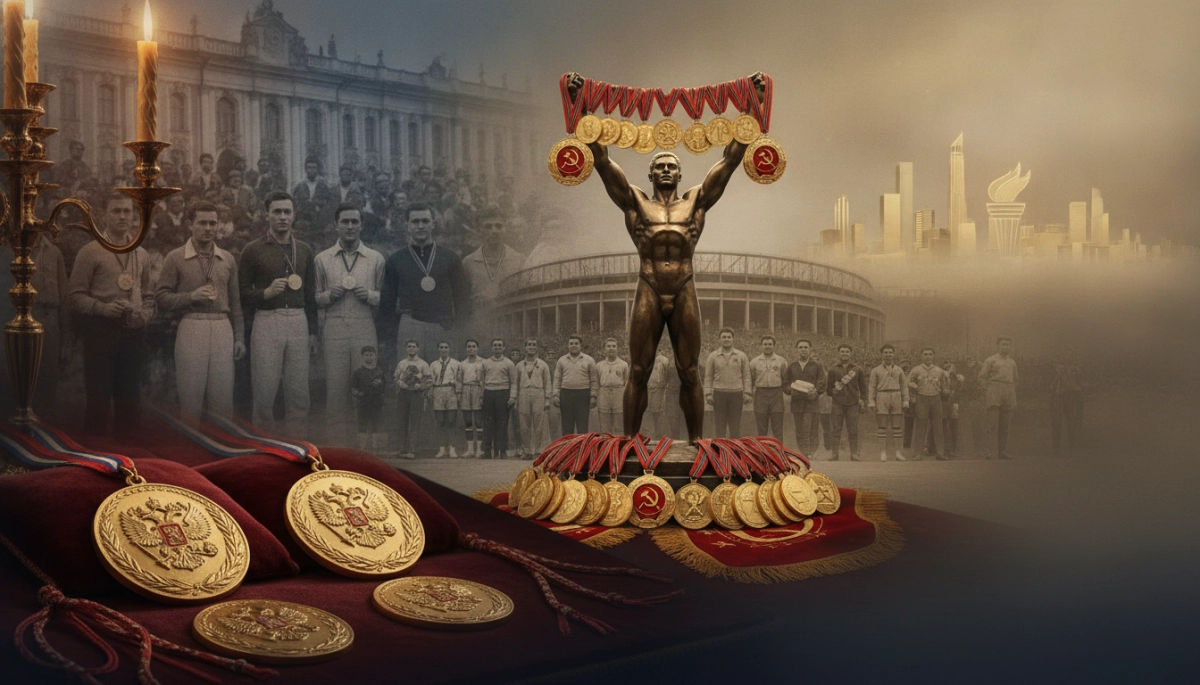
A Nation Built for Competition: Russia’s Olympic Origins
Few nations have shaped the modern Olympic movement as profoundly — or as dramatically — as Russia. When the first modern Games were held in Athens in 1896, the Russian Empire sent no official delegation. Individual athletes made the journey at their own expense, reflecting how loosely organized the country’s sporting infrastructure was at the time. That absence proved temporary. Within a generation, Russia was competing on the world stage — and within half a century, it would come to dominate it.
The Russian Empire officially entered Olympic competition at the 1900 Paris Games and made its most notable pre-revolutionary appearance at the 1908 London Olympics, where figure skater Nikolai Panin became the first Russian Olympic champion in history. His gold medal in the special figures event was a quiet milestone that would take on outsized significance as the decades unfolded. Silver medals in wrestling at those same Games hinted at the competitive depth that existed within Russian sport long before a centralized system existed to cultivate it.
The collapse of the Russian Empire in 1917 and the founding of the Soviet Union effectively erased Russia from the Olympic stage for decades. The new communist government dismissed the Games as a bourgeois spectacle, and the USSR remained absent until 1952. What might have been achieved had those generations of athletes competed is one of sport history’s great counterfactuals — a question that frames everything that followed.
The Soviet Machine: How the USSR Redefined Olympic Dominance
When the Soviet Union arrived at the 1952 Helsinki Olympics, the impact was immediate. The USSR finished level with the United States in gold medals, stunning Western observers who had assumed American athletic supremacy was unassailable. It was no accident. Soviet sport had been methodically constructed since the 1920s — a state apparatus designed to identify talent early, train athletes with scientific rigor, and deliver results that served as ideological proof of communism’s superiority over capitalism.
Over the following four decades, the Soviet model produced a staggering accumulation of gold medals across an extraordinary range of disciplines. Gymnastics, weightlifting, wrestling, athletics, swimming, fencing — the USSR collected gold in events both glamorous and obscure. Gymnast Larisa Latynina, who won nine Olympic gold medals, and triple jumper Viktor Saneyev cemented their places among the greatest Olympians in history. The Cold War gave these victories a meaning that extended well beyond sport. Training facilities, sports schools, and athlete support systems were funded at levels few Western nations could match, producing generation after generation of elite performers.
Cracks in the Colossus: Boycotts, Doping, and the Limits of the Soviet System
For all its brilliance, the Soviet Olympic machine was never without contradictions. The 1980 Moscow Olympics represented both a pinnacle and a warning. The American-led boycott — a response to the Soviet invasion of Afghanistan — stripped the competition of key rivals, casting a shadow over every gold medal won that summer. Four years later, the USSR and its Eastern Bloc allies boycotted the Los Angeles Games, ensuring an entire generation of athletes on both sides never truly measured themselves against one another when it mattered most.
The doping question was more corrosive still. State-sponsored performance enhancement was not unique to the Soviet Union, but the scale and systematization of Soviet pharmaceutical support was considerable. Evidence emerging in subsequent decades showed that victories across multiple sports had been achieved with chemical assistance, muddying the historical record and inviting uncomfortable reappraisals of achievements that had once seemed simply magnificent. These chapters cannot be omitted — they are part of the same story.
The Fall and the Reckoning: Russian Sport After 1991
The dissolution of the Soviet Union in 1991 created an immediate and profound crisis. Overnight, the funding infrastructure that had sustained elite athletics for decades evaporated. Sports schools closed. Coaches emigrated. Athletes who had trained within a system that provided everything suddenly found themselves navigating a chaotic transition economy with almost none of those supports in place.
The 1992 Barcelona Olympics illustrated the complexity of the transition. Athletes from the former Soviet republics competed together as the Unified Team, winning more gold medals than any other nation — a final, ghostly expression of Soviet athletic culture competing under a flag that no longer represented any existing country. When Russia competed independently from 1994 onward, decline from Soviet-era heights was measurable but not catastrophic. Figure skating, rhythmic gymnastics, wrestling, and weightlifting held on. But the breadth that had once defined Soviet supremacy — the ability to compete at the highest level across virtually every discipline simultaneously — was gone.
Rebuilding the Infrastructure of Excellence
Through the late 1990s and into the 2000s, Russian sport began a slow, uneven reconstruction. Federal investment returned gradually, and a new generation of administrators sought to reverse the talent drain. Results were mixed but periodically spectacular, with performances at Sydney 2000 and Athens 2004 demonstrating that elite-level production remained intact in certain disciplines. What emerged was a leaner, more selective version of the old model — one that concentrated resources where returns were most reliable, even if comprehensive dominance remained out of reach.
The Doping Era and Its Consequences: Russia’s Most Difficult Chapter
The 2014 Sochi Winter Olympics, hosted on Russian soil, appeared at first to mark a triumphant restoration of Russian sporting prestige. Russia topped the medal table with thirteen gold medals — its best Winter Olympic performance in the post-Soviet era. What followed was one of the most damaging scandals in Olympic history.
Investigations led by the World Anti-Doping Agency produced compelling evidence of a state-directed doping program operating across multiple sports during the Sochi Games and beyond. The McLaren Report, published in 2016, documented a systematic scheme involving the manipulation of urine samples and the involvement of Russian security services — a level of institutional coordination that left little room for any defense of individual ignorance. The consequences were severe: Russian athletes were barred from competing under their national flag at the 2016 Rio Olympics and again at subsequent Games, forced to compete as neutrals under various designations.
The medals won during that period carry a legitimacy problem that will take generations to resolve. Some have been redistributed following retesting of stored samples. Others remain subject to ongoing legal proceedings. For anyone tracing Russia’s Olympic gold medal legacy with intellectual honesty, the Sochi era must be weighed with the same seriousness as the triumphs of Latynina or the breakthroughs of 1952.
Gold in the Shadow of Sanctions: Post-Sochi Russia at the Olympics
Despite the institutional cloud, individual athletes continued to perform at the highest level. At the Tokyo 2020 Olympics — held in 2021 — Russian competitors appeared under the ROC banner and still won twenty gold medals, underscoring a persistent truth: the talent pipeline, even under significant disruption, continued to produce genuinely elite performers. The invasion of Ukraine in February 2022 deepened Russia’s international isolation further, with Paris 2024 seeing only a small number of athletes permitted to compete as Individual Neutral Athletes under strict eligibility conditions. Whether the conditions for a full return will materialize, and what form Russian Olympic identity will take if they do, remains one of sport’s most consequential open questions.
A Legacy Measured in More Than Medals
Russia’s Olympic gold medal history is ultimately a story about power — the power of state investment in human performance, the power of ideological motivation, and eventually the corrupting power of a system willing to win at any cost. It is also a story about individual excellence that transcends institutional context. Nikolai Panin’s artistry on the ice in 1908 had nothing to do with state machinery. Latynina’s nine gold medals reflected a competitive genius no political system could manufacture from nothing.
Understanding that duality — genuine greatness alongside documented corruption — is what separates an honest reckoning with this legacy from either hagiography or dismissal. Russia’s contribution to Olympic sport is embedded in the fabric of the Games themselves. The coaching methodologies developed within the Soviet system spread globally as emigrant coaches carried their knowledge to new countries and generations. The official Olympic record of Russian participation captures the statistics, but the influence runs considerably deeper.
What endures, beyond medal tallies and controversy, is the image of a nation that treated athletic competition as a serious national endeavor — sometimes to its great credit, sometimes to its profound shame. That seriousness, for better and worse, is Russia’s most lasting Olympic inheritance. No future chapter of the story will be fully intelligible without understanding how that inheritance was built, how it was sustained, and how it was eventually, in critical ways, squandered.