Crossing the Iron Curtain: When Soviet Athletes Chose the West
The Cold War’s Most Personal Battleground: Sport and Sovereignty
For most of the twentieth century, the Soviet Union treated its athletes as instruments of state power — living proof that the communist system could outperform the capitalist world on any stage it chose, including the Olympic podium. Soviet athletes enjoyed privileges unavailable to ordinary citizens: better housing, access to foreign goods, relative freedom of movement. But that movement was always supervised, always conditional, and always reversible.
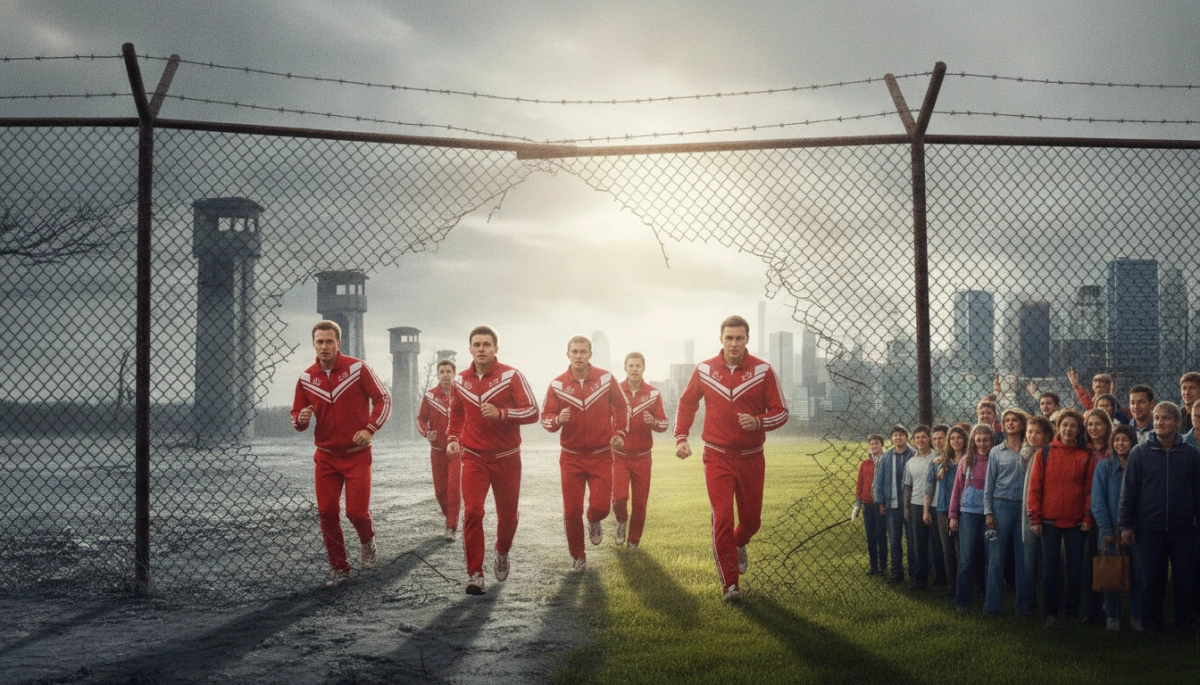
To defect was not merely a personal decision. It was a political act, a public repudiation of the Soviet state that reverberated from Moscow to Washington. For gymnasts, chess grandmasters, hockey players, and ballet dancers alike, crossing meant severing ties with family, identity, and homeland — often permanently. The Cold War had many frontlines, but few were as intimate as this one.
Understanding why some of the most celebrated Soviet athletes chose to abandon the system that had trained and elevated them requires looking honestly at both sides: what the state offered, and what it ultimately could not provide. Freedom of expression, professional autonomy, the right to earn commercially from one’s own talent — these were not abstractions. For an athlete at the height of their career, they were immediate, pressing realities.
Between Loyalty and Liberty: The Conditions That Made Defection Thinkable
Travel abroad for Soviet athletes was never routine. Every international delegation operated under strict KGB oversight. Coaches, officials, and fellow athletes could all serve as informants. For high-profile competitors, this meant rooming arrangements designed to prevent isolation, curfews during tournaments, and carefully orchestrated contact with foreign media.
Yet the very exposure the Soviet system feared was also unavoidable. To compete internationally was to experience the contrast firsthand — Western shop windows, the relative openness of foreign press, the financial rewards available to professional athletes in capitalist markets. For many, the contrast remained a private observation. For a significant few, it became impossible to ignore.
The sports that produced the highest defection rates were not accidental. Tennis, figure skating, gymnastics, and hockey all required sustained international competition during formative years, and all produced athletes with individualistic mindsets — performers whose identity was inseparable from personal expression. The state could control schedules and restrict earnings, but it struggled to suppress the ambitions of someone who had spent a lifetime developing a highly personal craft.
The Faces Behind the Defections: Stories That Defined an Era
The political machinery only fully comes into focus through the individuals who actually made the choice. These were not ideologues or dissidents in the conventional sense. They were people who had dedicated their entire lives to a discipline, only to conclude that the system surrounding it was incompatible with who they had become.
Alexander Mogilny’s defection in 1989 arrived with particular dramatic charge. One of the most gifted hockey players of his generation, Mogilny vanished from the Soviet national team’s hotel during the World Championships in Stockholm. He was twenty years old. The Buffalo Sabres, who had secretly drafted him two years earlier in anticipation of exactly this possibility, had personnel waiting to receive him. Within days, a celebrated Soviet asset was skating in the NHL. The operation underscored something important: Western sports organizations were not passive recipients of defectors. They were, at times, active participants — alert to the intelligence that the right individual, at the right moment, might be ready to leave.
Martina Navratilova’s story illuminates a different dimension. Born in Czechoslovakia and shaped by Eastern Bloc sporting infrastructure, she requested asylum in the United States in 1975 at eighteen. Her reasoning was direct: she wanted to play professional tennis on her own terms, earn what the market would bear, and live without state officials controlling her schedule, earnings, and public persona. The Czechoslovak authorities responded by stripping her of citizenship and, for a time, denying her family the right to communicate with her. The personal cost was immediate and severe. The professional rewards were ultimately extraordinary — but the two facts coexisted rather than canceling each other out, and Navratilova has spoken candidly throughout her life about the grief embedded within her success.
The Weight of What Was Left Behind
What distinguishes these stories from simpler narratives of liberation is precisely what defectors carried with them. Leaving did not mean leaving cleanly. Families back home faced interrogation, professional consequences, and social stigma. Parents lost jobs. Siblings were passed over for opportunities. The Soviet state understood collective vulnerability, and it deployed that understanding deliberately.
This is why many athletes who privately harbored doubts ultimately chose to return home. The threshold was not simply a question of personal courage — it was a question of how much harm one was willing to absorb and transmit in pursuit of a different kind of life. Those who did defect often carried a form of survivors’ guilt that rarely made it into Western press coverage, which preferred the cleaner story of individuals choosing freedom over oppression.
The State’s Response: Control, Punishment, and Propaganda
The Soviet apparatus did not respond to defections passively. Each high-profile departure triggered an institutional response designed both to punish those who had left and to deter anyone else considering a similar move.
Immediate consequences typically included:
- Public denunciation in state media, framing defectors as ideologically compromised, mentally unstable, or manipulated by Western intelligence services
- Erasure from official sports records where possible, removing photographic evidence and references from publications and broadcasts
- Professional and social sanctions applied to the defector’s family members remaining in the Soviet Union
- Enhanced surveillance protocols for future international delegations, including reduced squad sizes and more intensive vetting
Soviet state media rarely acknowledged defections directly, preferring to suggest that individuals had been corrupted by Western materialism rather than motivated by anything the Soviet system might legitimately be held responsible for. Behind the public response, however, the KGB conducted thorough post-mortems after each departure — evaluating where surveillance had failed and which signals had been missed. Defections were treated not merely as propaganda defeats but as security failures, evidence of a persistent gap between the system’s self-image and its actual capacity to manage the human beings within it.
How History Remembers Them
Decades after the Soviet Union ceased to exist, athletes who defected occupy strikingly different places in collective memory. In the West, the dominant narrative has long been one of vindication — individuals who chose authenticity over obligation. In Russia, the picture is considerably more complicated. Some were gradually rehabilitated: Mogilny was eventually welcomed into Russian hockey’s institutional memory, his NHL achievements recognized alongside his Soviet career rather than in opposition to it. Others remained figures of ambivalence, their stories too entangled with national pride and historical grievance to be resolved tidily.
Navratilova’s relationship with her Czech homeland followed a similarly uneven arc. The country that stripped her of citizenship eventually honored her, and she has spoken at length about her complicated affection for a place that once treated her departure as betrayal. These partial reconciliations suggest something important: defection was never simply an endpoint. It was the beginning of a longer, quieter negotiation between individuals and the identities they had been assigned.
The Athletes Who Stayed — and What Their Silence Meant
Any honest accounting must also consider the athletes who contemplated leaving and did not. Their stories are largely invisible, filtered out by how history preserves dramatic acts over quiet endurance. Yet their decisions — to compete within the system, to accept its constraints, to find meaning despite them — were no less consequential for being less visible. Choosing to remain was not always a failure of courage. Sometimes it was a different form of love, directed toward family, community, or a homeland whose government they distinguished from the country itself.
The Enduring Resonance of a Choice Made Under Pressure
What makes these stories genuinely lasting is not their Cold War political context but what they reveal about the relationship between individual identity and institutional power. Every athlete who walked away from a delegation hotel or declined to board a plane home was testing a question that extends well beyond sport and ideology: at what point does a person’s allegiance to themselves outweigh their allegiance to the system that made them?
The freedoms they gained were real, and so were the losses they sustained. The courage involved was genuine, and so was the grief. The Western world that received them offered opportunity and warmth — but it also had its own expectations and its own ways of using exceptional people for institutional purposes.
What endures most powerfully is not the drama of any individual departure but the human clarity those departures produced. For a brief, defining moment, an athlete would step outside every structure that had shaped them — the training regime, the political apparatus, the national identity — and act entirely on their own judgment. Whether history has been generous or ambivalent toward that act depends greatly on who is writing it. But the act itself, in its vulnerability and irreversibility, belongs to the individuals who made it. That, perhaps more than anything else, is what the Soviet state could never fully account for: that even the most comprehensively managed human being retains, in the end, the capacity to simply decide for themselves.