
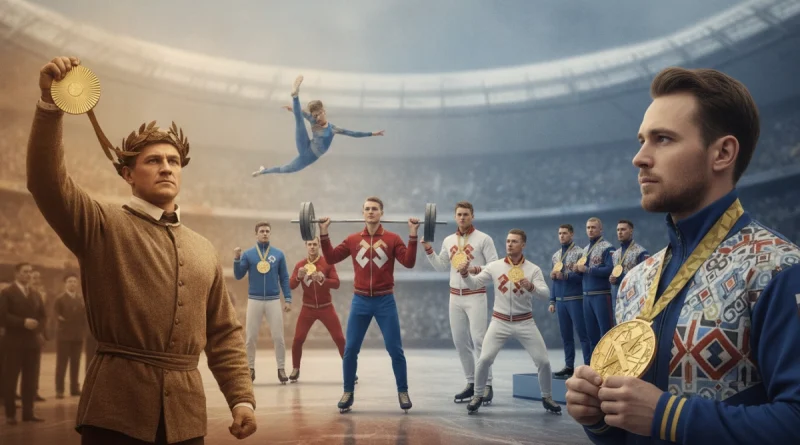
Olympic Gold and the Russian Soul: A Century of Champions from Tsarist Roots to Modern Controversy
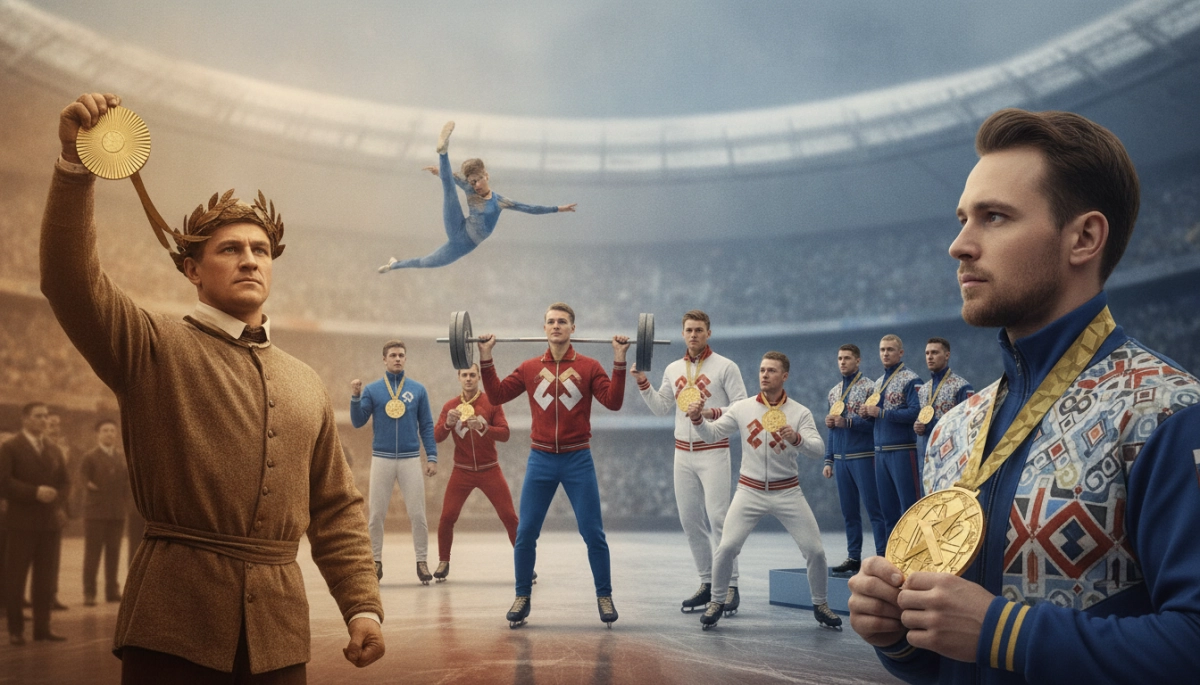
From St. Petersburg to Helsinki: How Russia First Met the Olympic Stage
Long before the Soviet Union announced itself as a sporting superpower, the Russian Empire sent its first athletes to the Olympic Games at the dawn of the twentieth century. The results were modest — a handful of competitors, no gold medals, and virtually no infrastructure behind the effort. Yet that early presence planted the seed of something that would, within half a century, become one of the most formidable athletic machines the world had ever seen.
Russia competed under the Imperial flag at the 1900 Paris Games and again in 1908 and 1912, collecting a small number of medals across wrestling and figure skating. Nikolai Panin-Kolomenkin’s gold in figure skating at London 1908 stands as the lone Olympic gold from the Tsarist era — a solitary achievement that reads almost like a prologue. The Revolution of 1917 shattered the continuity entirely. The new Soviet state rejected the International Olympic Committee as a bourgeois institution and spent the following decades building an alternative sporting ideology rooted in collective strength rather than aristocratic leisure. That ideological detour would make the USSR’s eventual Olympic debut all the more explosive.
Helsinki 1952 and the Birth of a Sporting Superpower
When Soviet athletes stepped onto an Olympic track in Helsinki in 1952, the world witnessed something genuinely unprecedented. Nina Romashkova’s gold in the women’s discus throw became the first Soviet Olympic gold medal — and it would not remain lonely for long. By the closing ceremony, the USSR had announced itself as a direct challenger to American dominance. The Cold War had found its sporting arena.
What followed over the next four decades was a record almost incomprehensible in scale. The Soviet Union accumulated more than 1,200 Olympic medals in total, with nearly 500 gold. At six of its nine Summer Olympics appearances, the USSR finished first in the gold medal count. At the Winter Games, it claimed first place seven times. These numbers reflect a state apparatus that identified sport as a legitimate instrument of geopolitical power and invested accordingly.
The names that emerged became synonymous with Olympic excellence. Gymnast Larisa Latynina won 18 medals across three Games — a record that stood until Michael Phelps surpassed it in 2012. Weightlifters, wrestlers, cross-country skiers, and rowers dominated their disciplines with institutional consistency. For anyone tracing olimpijski šampioni rusija, this Soviet chapter is the definitive one. Behind it lay centralized training facilities, state-sponsored sports science, and a talent identification system that reached into every Soviet republic — real machinery producing real performances.
The Faces Behind the Medal Count: Individual Stories From the Soviet Golden Age
Statistics tell part of the story, but they flatten the human texture that made the Soviet Olympic era so compelling. Each gold medal represents a person who trained under extraordinary pressure, often in conditions of severe material scarcity, carrying national expectation alongside private ambition.
Valery Borzov is perhaps the most instructive example. Winning the 100 meters and 200 meters at Munich in 1972, he became the first European sprinter to claim the blue-ribbon event in the modern era — a discipline the United States had regarded as practically its own. His victories came through a meticulous scientific approach to running mechanics years ahead of Western methodology. He was not simply fast; he was refined through biomechanical analysis and structured periodization that Soviet sports science had quietly developed for a generation.
Then there was Elena Belova in fencing and Irina Rodnina across three consecutive Winter Games in pairs figure skating — winning gold with two different partners, a testament to her own supremacy. Soviet hockey dominated the Olympic ice from 1956 onward with a style that rewrote how the game was understood at the highest level. These athletes existed within the system but transcended it. Their excellence was not manufactured; it was cultivated, which is a meaningfully different thing.
The Boycott Years and What Was Lost
Any honest accounting of Soviet Olympic gold must grapple with the distortions created by the boycotts of 1980 and 1984. When the United States led nations in boycotting the Moscow Games following the Soviet invasion of Afghanistan, and the Soviet Union reciprocated at Los Angeles four years later, the medal tables of both Games became statistical anomalies rather than true measures of global competition. The USSR’s 80 golds at Moscow 1980 came in the absence of dozens of elite competitors who would have meaningfully contested several events. This does not diminish the athletes who competed, but it complicates the historical record in ways analysts continue to debate.
Transition and Turbulence: From Soviet Republics to the Russian Federation
The dissolution of the Soviet Union in 1991 created an immediate practical problem for international sport. Athletes who had trained under one flag suddenly found themselves citizens of fifteen different countries. At the 1992 Barcelona Games, a diplomatic compromise produced the Unified Team — athletes from twelve former Soviet republics competing under the Olympic flag. That team won 45 gold medals and finished first overall, suggesting the talent pipeline was still intact even as the political structure collapsed.
From 1994 onward, Russia competed as an independent nation. The country retained Soviet-era coaching expertise and infrastructure in wrestling, weightlifting, and gymnastics, but the economic chaos of the 1990s gutted funding across many sports. Gold medals still came — Alexander Popov in swimming, Russian women’s dominance in rhythmic gymnastics, continued excellence in combat sports — but the industrial consistency of the Soviet era was gone. What emerged through the late 1990s and into the 2000s was a Russian Olympic identity simultaneously heir to the Soviet legacy and struggling to define itself on new terms.
The Doping Era, Neutral Flags, and Russia’s Fractured Olympic Present
The twenty-first century brought Russia genuine athletic brilliance alongside a crisis of institutional credibility without precedent in Olympic history. At Athens, Turin, Beijing, and Sochi, Russian athletes won gold across a remarkable range of disciplines — from figure skater Evgeni Plushenko to wrestler Buvaisar Saitiev, who claimed three Olympic titles across three different Games. These were performances that would have commanded straightforward admiration in any other context. The context became impossible to ignore.
The McLaren Report of 2016 documented a state-sponsored doping program of extraordinary scope centered on the Sochi Winter Games. The findings described a systematic operation involving the Russian security services, the Ministry of Sport, and deliberate manipulation of sample-testing infrastructure. The consequences were sweeping. Russia was barred from competing under its flag at PyeongChang 2018 and again at Tokyo 2020 and Beijing 2022. At Paris 2024, eligible athletes competed only as Individual Neutral Athletes, stripped of national identification entirely.
The athletes who competed under neutral banners — many talented, some untouched by any personal doping finding — carry the weight of an institutional failure not of their making. Their gold medals exist in the record books without a national flag attached, a strange and melancholy outcome for competitors who trained their entire lives representing a specific country and tradition.
A Legacy Measured in More Than Gold
Surveying a century of Russian and Soviet Olympic gold medals — from Panin-Kolomenkin’s solitary title in 1908 to the complicated present of neutral flags — what emerges is a story far richer and more contradictory than any simple triumph narrative could contain. The Soviet era produced genuine greatness: athletes of extraordinary skill, coaches who advanced the science of human performance, and competitive standards that raised every discipline they touched. That legacy belongs to the athletes who achieved it, regardless of how the political system surrounding them is judged.
Russia’s post-Soviet identity has been defined by the tension between that inheritance and the institutional failures that shadowed it. The International Olympic Committee’s official records capture the numerical scale of that achievement, but numbers alone cannot convey the full arc — the imperial modesty of the early 1900s, the explosive arrival at Helsinki, the Cold War dominance, the post-Soviet reinvention, and the painful reckoning of recent decades.
What the survey ultimately reveals is that Olympic gold, for Russia, has never been merely athletic. It has been political, ideological, scientific, and deeply personal all at once. That layered complexity is precisely what makes this history worth tracing in full, and what ensures it will continue to evolve long after the current controversies resolve themselves into the next chapter of a story that is, by any honest measure, far from finished.